

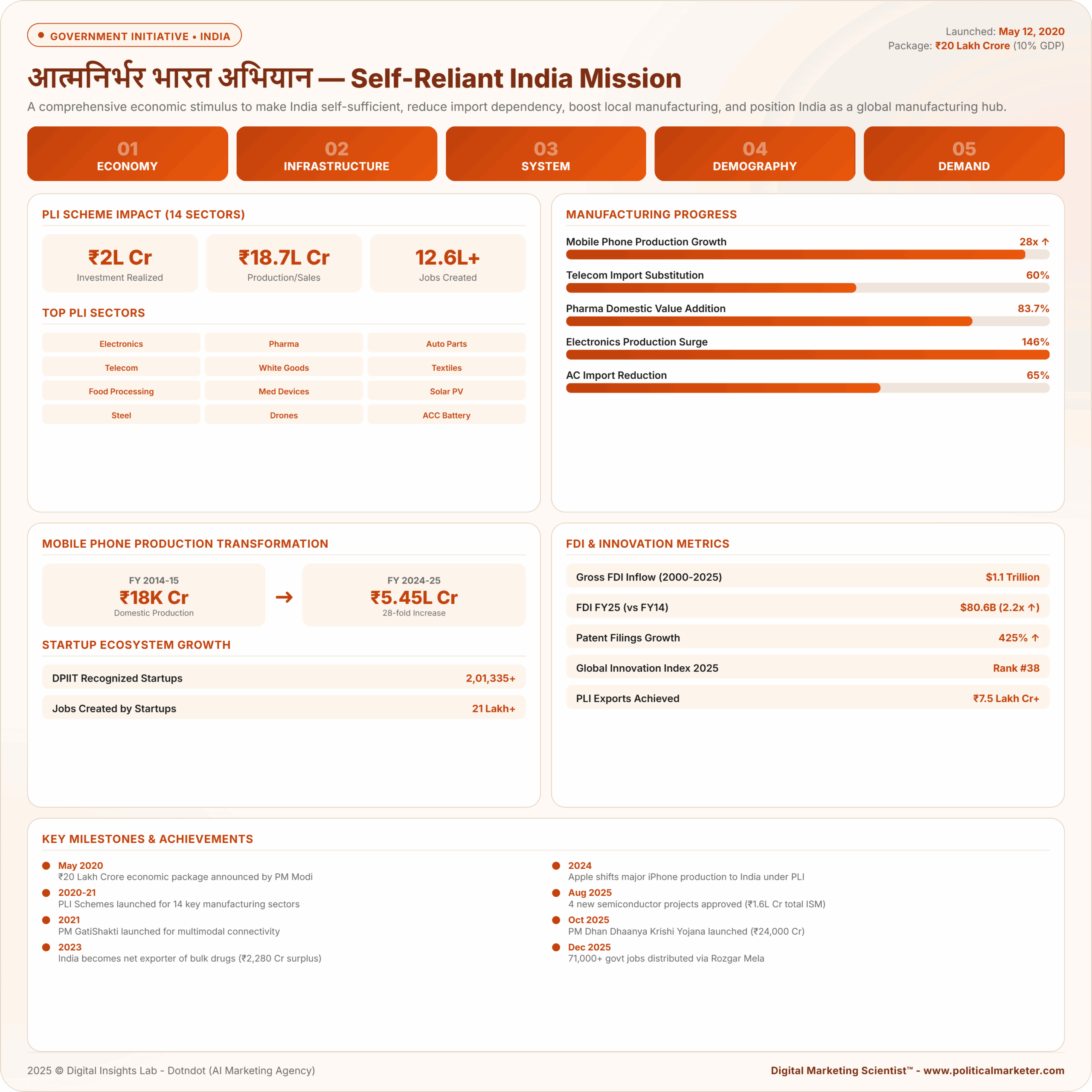
Aatmanirbhar Bharat Abhiyan, meaning Self-Reliant India Mission, is a comprehensive national initiative launched to strengthen India’s economic resilience, reduce excessive dependence on imports, and build globally competitive domestic capabilities.
The programme’s vision is not economic isolation but deeper integration into the global economy, supported by stronger internal capacity, innovation, and productivity. It aims to position India as a reliable hub for manufacturing, services, and technology while ensuring inclusive and sustainable growth.
At its core, the initiative focuses on enhancing domestic production across critical sectors, including manufacturing, agriculture, infrastructure, defence, electronics, pharmaceuticals, energy, and digital services.
It encourages Indian industries to scale up operations, adopt modern technologies, and improve efficiency, enabling locally produced goods to meet both domestic and international demand. Strengthening internal supply chains is central to protecting the economy from global disruptions and external shocks.
A key pillar of Aatmanirbhar Bharat Abhiyan is support for Micro, Small, and Medium Enterprises, which form the backbone of employment generation and industrial output in India.
The mission introduced structural measures to improve access to credit, simplify regulatory compliance, expand market opportunities, and promote formalisation. These steps are intended to help MSMEs grow sustainably, integrate digital tools, and participate more effectively in national and global value chains.
The initiative places strong emphasis on long-term policy and structural reforms rather than temporary relief measures.
Reforms to labour regulations, agricultural marketing systems, tax structures, production-linked incentives, and ease of doing business are designed to create a stable, competitive economic environment.
These changes aim to attract sustained investment, enhance productivity, and encourage greater private sector participation.
In the agriculture and rural economy, the Aatmanirbhar Bharat Abhiyan seeks to strengthen farm incomes and rural Employment by improving supply chains, storage capacity, food-processing infrastructure, and market connectivity.
By reducing post-harvest losses and promoting value addition, the programme supports a shift from subsistence agriculture to market-linked, technology-enabled farming. This approach also encourages rural entrepreneurship and the growth of agri-based industries.
Another critical dimension of the mission is technological and digital self-reliance. By aligning with Digital India initiatives, the programme promotes the indigenous development of digital infrastructure, platforms, and innovation ecosystems.
This includes building domestic capacity in electronics manufacturing, data infrastructure, fintech, and emerging technologies, while also supporting startups, research institutions, and innovation-driven enterprises.
The mission also focuses on strategic sectors such as defence and critical infrastructure, where reducing import dependence is closely linked to national security and long-term sovereignty.
By encouraging domestic manufacturing, joint ventures, and technology partnerships, the initiative aims to develop strong indigenous capabilities while maintaining constructive engagement with global partners.
Aatmanirbhar Bharat Abhiyan represents a long-term economic transformation strategy rather than a single policy intervention. It combines domestic strength with global competitiveness, reform-driven growth with social inclusion, and self-reliance with international cooperation.
The initiative envisions an India that can meet its own needs, contribute meaningfully to global supply chains, and sustain resilient, inclusive, and future-ready economic growth.
What Is Aatmanirbhar Bharat Abhiyan and How It Aims to Build a Self-Reliant Indian Economy
Aatmanirbhar Bharat Abhiyan is a national economic initiative designed to strengthen India’s domestic capabilities while remaining actively connected to global markets. The mission focuses on reducing excessive import dependence by expanding local manufacturing, supporting MSMEs, improving supply chains, and encouraging innovation across key sectors, including agriculture, infrastructure, technology, defence, and digital services. Through structural reforms, policy stability, and investment-led growth, the initiative aims to build a resilient, competitive, and self-sustaining Indian economy that can withstand global disruptions and contribute meaningfully to international value chains.
Understanding Aatmanirbhar Bharat Abhiyan
Aatmanirbhar Bharat Abhiyan is a national economic mission focused on strengthening India’s domestic economic capacity, reducing reliance on imports, and increasing domestic production. The goal is not isolation from global markets. The goal is to ensure that Indian businesses, workers, and supply chains remain strong even when global conditions turn unstable. You see this approach reflected in reforms, incentives, and sector-focused policies that support long-term economic stability.
This mission treats self-reliance as a form of economic preparedness. When domestic industries grow, you gain more substantial Employment, steadier supply chains, and better control over essential goods and services.
Core Objectives of the Mission
The initiative aims for clear, measurable outcomes that directly affect you and the broader economy.
Key objectives include
- Expanding domestic manufacturing and production capacity
- Reducing dependence on critical imports
- Supporting job creation across urban and rural regions
- Improving productivity through technology and process reform
- Strengthening India’s role in global supply chains
These objectives guide policy design across sectors rather than existing as standalone goals.
Focus on Domestic Manufacturing and Supply Chains
Aatmanirbhar Bharat places manufacturing at the center of economic growth. When production shifts closer to home, you reduce exposure to global supply disruptions and cost volatility. The mission encourages industries to modernize their plants, adopt efficient processes, and scale up production for both domestic use and exports.
You also benefit from stronger internal supply chains that connect raw materials, logistics, processing, and final production within the country. This structure supports consistency, pricing control, and faster response during crises.
Support for MSMEs and Employment
Micro, Small, and Medium Enterprises play a direct role in Employment and local economic activity. The mission strengthens this segment through targeted credit access, simplified compliance rules, and improved market reach.
For you, this means
- More local job opportunities
- Stronger regional business ecosystems
- More involvement of small firms in national projects
- Increased formalization and financial stability
By supporting MSMEs, the mission spreads economic growth beyond major industrial centers.
Structural and Policy Reforms
Aatmanirbhar Bharat emphasizes reforms over temporary relief. These reforms improve how markets function and how businesses operate.
Key reform areas include
- Labour regulations are designed to balance worker protection and flexibility.
- Tax systems that reduce friction and improve compliance
- Production-linked incentives that reward actual output
- Business processes that reduce approval delays and uncertainty
These reforms aim to create a stable environment in which long-term investment decisions make sense.
Agriculture and Rural Economic Strength
The mission extends beyond industry into agriculture and rural livelihoods. When supply chains improve and storage capacity expands, you reduce waste and increase farmers ‘ incomes. The focus remains on value addition, processing, and market access rather than raw output alone.
This approach supports
- Better price realization for farmers
- Growth of food processing and agri-based enterprises
- Increased rural Employment beyond farming
You see rural growth treated as economic growth rather than a separate issue.
Technology and Digital Self-Reliance
Digital capacity plays a central role in economic independence. The mission promotes domestic development of electronics, platforms, and data infrastructure so you rely less on external systems for essential digital services.
This includes
- Local electronics manufacturing
- Support for startups and research-driven firms
- Expansion of digital public infrastructure
- Adoption of technology in manufacturing, agriculture, and services
You benefit through improved access, cost control, and data security.
Strategic Sectors and National Security
Specific sectors carry long-term security implications. Defence manufacturing and critical infrastructure receive focused attention to reduce reliance on foreign suppliers. Domestic production in these areas improves readiness, cost efficiency, and control over upgrades and maintenance.
For you, this translates into stronger public systems and reduced vulnerability during geopolitical disruptions.
How the Mission Shapes a Self-Reliant Economy
Aatmanirbhar Bharat Abhiyan treats self-reliance as capacity-building, not as withdrawal from global trade. You still engage with international markets, but from a position of strength. Domestic industries grow first, then compete globally.
The mission connects reform, investment, and production into a single economic direction. You see an economy designed to withstand shocks, generate Employment, and sustain growth over time without excessive dependence on external factors.
As one guiding idea often repeated in policy discussions puts “it
“Self-reliance means building strength at home so global engagement becomes a choice, not a necess” ty.”
Ways To Aatmanirbhar Bharat Abhiyan (Self-Reliant India)
Ways to Aatmanirbhar Bharat Abhiyan explains how India advances self-reliance through practical actions such as strengthening domestic manufacturing, supporting MSMEs, expanding agriculture and rural Employment, promoting local innovation, improving digital infrastructure, and aligning skills with industry needs.
These approaches focus on building internal capacity, reducing structural dependence on imports, and creating stable jobs while keeping India connected to global markets through competitive, reliable domestic systems.
Area of Focus: How It Contributes to Aatmanirbhar Bharat
Domestic Manufacturing Expands local production to reduce dependence on imported goods and retain value within the economy.
MSME Support Strengthens small and medium-sized enterprises by improving access to credit, streamlining regulations, and integrating them into supply chains.
Import Substitution Encourages local production of essential goods and components to lower structural import dependence.
Agriculture Value Addition Shifts farming from raw output to processing, storage, and market-linked income generation.
Rural Employment Creates non-farm jobs through agri-based industries, logistics, and rural manufacturing units.
Digital India Integration uses digital systems to improve manufacturing efficiency, compliance, payments, and market access.
Skill Development Aligns training programs with industry needs to build a job-ready workforce for manufacturing and services.
Startup and Innovation Support Encourages startups to develop and produce solutions locally rather than rely on imports.
Infrastructure Development Improves transport, power, storage, and logistics to support scalable domestic production.
Technology Capability Building Promotes the local development of electronics, platforms, and industrial technologies.
Public Procurement Preference creates a steady demand for domestically produced goods through government purchasing policies.
Export Readiness builds production scale and quality standards to enable Indian firms to compete in global markets.
Supply Chain Strengthening: Develop internal supplier networks to improve reliability and delivery consistency.
Policy and Regulatory Reforms provide predictable rules that support long-term investment and economic growth.
Strategic Sector Focus: Builds domestic capacity in defence, energy, electronics, and pharmaceuticals for economic security.
How Aatmanirbhar Bharat Abhiyan Supports MSMEs and Local Manufacturing Across India
Aatmanirbhar Bharat Abhiyan strengthens MSMEs and local manufacturing by improving access to finance, simplifying regulatory processes, and expanding market opportunities within India. The initiative focuses on building domestic supply chains, encouraging technology adoption, and supporting production-linked incentives that reward actual output. By reducing operational barriers and promoting formalisation, the mission helps small and medium enterprises scale operations, generate Employment, and integrate into national and global value chains, making local manufacturing more resilient and competitive across regions.
Why MSMEs Matter to Your Economy
Micro, Small, and Medium Enterprises form the foundation of India’s production and employment base. You see their impact in local manufacturing units, service providers, suppliers, and exporters spread across cities and towns. Aatmanirbhar Bharat Abhiyan treats MSMEs as drivers of economic stability rather than side players. The mission focuses on strengthening their capacity to reduce reliance on imports and increase domestic output.
Access to Finance That Supports Growth
Limited credit often restricts small businesses from expanding. The mission addresses this problem by improving access to formal financing and reducing risk. When MSMEs receive predictable credit support, they invest in machinery, hire workers, and expand operations.
You benefit through
- Higher employment generation in local markets
- Stronger small business participation in industrial supply chains
- Reduced dependence on informal borrowing
Claims related to credit expansion, loan guarantees, and MSME financing require data from government budget documents and RBI reports for verification.
More straightforward Rules and Lower Compliance Pressure
Complex regulations slow down small manufacturers. Aatmanirbhar Bharat focuses on simplifying compliance so you spend less time managing paperwork and more time running your business. Streamlined registration, faster approvals, and digital reporting reduce friction for new and existing enterprises.
This approach improves
- Ease of starting and running a business
- Transition from informal to formal operations
- Transparency in taxation and reporting
Strengthening Local Manufacturing Capacity
Local manufacturing sits at the heart of the mission. When production happens closer to demand, you reduce logistics costs and exposure to global supply disruptions. The initiative supports domestic manufacturers through output-based incentives, procurement support, and capacity expansion.
Key outcomes include
- Expansion of factory output across states
- Better integration of small units into large manufacturing ecosystems
- Improved product availability in domestic markets
Production-linked incentive claims require citation from official policy notifications.
Integration Into National Supply Chains
Aatmanirbhar Bharat helps MSMEs move beyond isolated operations. The focus remains on linking small manufacturers with large firms, exporters, and public procurement systems. When MSMEs join structured supply chains, they gain stable demand and predictable revenue.
This integration supports
- Standardized production practices
- Better quality control
- Long-term buyer relationships
Technology Adoption and Productivity
Low productivity limits competitiveness. The mission encourages MSMEs to adopt digital tools, modern equipment, and process improvements. When you adopt technology, output increases without a proportionate increase in costs.
Support areas include
- Digital payments and accounting systems
- Automation and machinery upgrades
- Skill development linked to production needs
Claims about productivity gains must be supported by industry or government studies.
Regional and Rural Industrial Growth
Manufacturing growth under Aatmanirbhar Bharat extends beyond large cities. Rural and semi-urban areas receive support through cluster development, logistics infrastructure, and local sourcing. This helps balance regional growth and reduces migration pressure.
You see results in
- Growth of district-level industrial clusters
- Expansion of local employment opportunities
- Stronger rural manufacturing ecosystems
Export Readiness and Market Expansion
The mission prepares MSMEs to compete beyond domestic markets. Export readiness programs, quality standards, and trade support help small manufacturers reach global buyers. When exports grow, you gain foreign exchange earnings and stable production demand.
Export-related impact claims require trade data from the DGFT and the Ministry of Commerce.
Why Aatmanirbhar Bharat Abhiyan Is CentraIndia’s Long-Term Economic Strategy
Aatmanirbhar Bharat Abhiyan is the Government of India’s long-term economic strategy, focusing on building domestic capacity to support stable, long-term growth. The initiative strengthens manufacturing, MSMEs, agriculture, and technology, reducing reliance on external supply chains during global disruptions. By prioritizing structural reforms, predictable policy, and production-driven incentives, the mission supports sustained job creation, regional development, and economic resilience, positioning India to compete globally from a position of internal strength.
A Strategic Shift Toward Economic Preparedness
Aatmanirbhar Bharat Abhiyan sits at the center of India’s long-term economic thinking because it focuses on preparation rather than reaction. You see the strategy shift from short-term fixes toward building systems that withstand global disruptions. The aim is simple. Strengthen domestic capacity so growth continues even when external supply chains fail.
This approach treats self-reliance as economic insurance. When local production, skills, and infrastructure grow together, you reduce exposure to global shocks.
Reducing Dependence on External Supply Chains
Heavy reliance on imports creates risk during global crises. Aatmanirbhar Bharat addresses this by expanding domestic manufacturing across essential sectors, including electronics, pharmaceuticals, defence, energy, and food processing.
For you, this means
- Fewer supply interruptions
- Better price stability
- Stronger control over essential goods
Claims related to import reductions and sectoral output require validation using trade data from government and commercial sources.
Manufacturing as a Long-Term Growth Engine
The strategy places manufacturing at the core of sustained growth. When domestic production increases, Employment rises, and value creation remains within the economy. Output-based incentives reward actual production rather than intent, which helps scale capacity over time.
You benefit through
- Steady job creation
- Expansion of industrial clusters
- Stronger linkages between large firms and small suppliers
Manufacturing growth figures require citation from official industrial and GDP reports.
Strengthening MSMEs for Economic Stability
Small and medium enterprises support both Employment and regional balance. Aatmanirbhar Bharat treats MSMEs as stabilizers of the economy, not backup players. Credit access, simplified compliance, and procurement support help these businesses survive downturns and expand during growth cycles.
This strengthens
- Local economies
- Supply chain resilience
- Income distribution across regions
Claims about MSME employment and output require data from the MSME ministry publications.
Structural Reforms Over Temporary Relief
The mission prioritizes reform instead of repeated emergency spending. Labour rules, tax systems, business approvals, and production incentives are subject to long-term adjustments to improve predictability.
For you, this creates
- More explicit rules for investment decisions
- Lower operating uncertainty
- Better planning horizons for businesses
Reform impact claims require policy documentation and economic assessments.
Agriculture and Rural Economic Integration
Long-term growth requires rural participation. Aatmanirbhar Bharat strengthens agriculture by improving storage, processing, and market access. This shifts income growth from raw output to value-added activity.
You see effects through
- Higher rural Employment
- Reduced post-harvest losses
- Growth of agri-based industries
Agricultural impact claims require support from farm income and production data.
Technology Capacity as Economic Control
Technology independence supports economic control. The mission advances domestic development of electronics, digital platforms, and data infrastructure to ensure essential systems remain accessible and affordable.
This focus supports
- Cost stability
- Data security
- Domestic innovation ecosystems
Technology output and adoption claims require backing from industry and government reports.
National Security and Strategic Autonomy
Economic strength links directly to national security. Domestic capability in defence manufacturing and critical infrastructure reduces reliance on foreign suppliers for sensitive needs. This gives you greater control over maintenance, upgrades, and readiness.
Security-related manufacturing claims require citation from defence production data.
How Government Reforms Under Aatmanirbhar Bharat Are Reducing Import Dependence
Government reforms under the Aatmanirbhar Bharat Abhiyan focus on expanding domestic production to reduce reliance on imported goods across key sectors. Policy measures such as output-linked incentives, simplified regulations, improved access to finance, and support for local manufacturing strengthen internal supply chains. By encouraging domestic production of essential goods and improving cost competitiveness, these reforms reduce exposure to global disruptions while supporting steady Employment and long-term economic stability.
Why Import Dependence Became a Policy Risk
High reliance on imports exposes you to supply shocks, price volatility, and external pressures during global disruptions. Aatmanirbhar Bharat Abhiyan treats this risk as a structural problem rather than a temporary setback. The focus remains on building domestic capacity to ensure essential goods remain available and affordable even when global trade slows or halts.
Production-Focused Policy Design
Government reforms under Aatmanirbhar Bharat reward actual output rather than intent. Policies target sectors where imports dominate domestic demand and where local production can scale with support.
You see this approach through
- Output-linked incentives tied to verified production
- Sector-specific manufacturing support
- Clear eligibility rules that reduce uncertainty
Claims about output growth and sector coverage require verification from official policy notifications and budget documents.
Expanding Domestic Manufacturing Capacity
Reforms encourage firms to establish or expand manufacturing units in India. When production shifts home, you reduce exposure to foreign suppliers and logistics risks. The government supports capacity expansion through access to infrastructure, procurement support, and cost rationalization.
This results in
- Higher domestic availability of essential goods
- Lower import bills over time
- Better control over pricing and supply continuity
Manufacturing expansion claims require support from industrial output and trade data.
Simplified Rules That Speed Up Local Production
Complex approval processes delay domestic production and raise costs. Aatmanirbhar Bharat simplifies compliance, enabling manufacturers to move faster from planning to production. Digital clearances, reduced paperwork, and time-bound approvals help you bring products to market without long delays.
This improves
- Time-to-production
- Cost predictability
- Business confidence
Strengthening MSMEs as Import Substitutes
Small manufacturers play a direct role in replacing imports, especially in components, intermediate goods, and consumer products. Improve MSMEs’ access to credit, public procurement, and supply chains to enable them to compete with imported alternatives.
You gain through
- Growth of local suppliers
- Reduced reliance on imported components
- Job creation close to consumption centers
MSME substitution impact requires data from the MSME ministry and procurement portals.
Public Procurement as a Demand Anchor
Government procurement policies prioritize domestically produced goods where feasible. This creates assured demand for local manufacturers and reduces dependence on imported supplies for public projects.
For you, this means
- Stable production demand
- Predictable revenue for domestic firms
- Faster scaling of local capacity
Procurement preference claims require backing from official procurement guidelines.
Technology and Capability Development
Reducing imports requires capability, not just protection. Reforms support technology adoption, skill development, and process improvements to ensure domestic products meet quality and cost standards.
Support areas include
- Machinery upgrades
- Skill-linked production training
- Quality certification systems
Claims about productivity and quality improvements require industry or government assessments.
Sector-Specific Import Reduction Strategy
Aatmanirbhar Bharat targets sectors with persistent import dependence, including electronics, defence equipment, pharmaceuticals, energy components, and food processing. Policies differ by sector but follow a common logic. Build capacity, ensure demand, and scale output.
Sector-level import reduction claims require trade and customs data.
What Are the Key Pillars of Aatmanirbhar Bharat Abhiyan Explained in Simple Terms
Aatmanirbhar Bharat Abhiyan rests on a set of clear pillars focused on strengthening the Indian economy. These include expanding domestic manufacturing, supporting MSMEs, improving agriculture and rural livelihoods, investing in technology and digital systems, maintaining infrastructure, and implementing long-term policy reforms. Together, these pillars help you rely more on local production, create stable jobs, reduce import dependence, and build an economy that remains stable amid global disruptions while remaining connected to international markets.
Core Idea Behind the Mission
Aatmanirbhar Bharat Abhiyan focuses on strengthening the country’s economy, so it relies less on imports and external systems. The mission views self-reliance as capacity-building, not isolation. You still engage with global markets, but from a position of domestic strength.
The pillars below explain how the mission works in practice and how each area affects your economy and daily life.
Domestic Manufacturing and Production
Domestic manufacturing forms the base of the mission. When goods are produced locally, you reduce exposure to global supply disruptions and pricing shocks. The focus remains on scaling production across sectors such as electronics, pharmaceuticals, defence equipment, consumer goods, and industrial components.
This pillar supports
- Higher availability of locally made goods
- More stable prices over time
- Job creation close to consumption centers
Claims on output growth and import reduction require support from industrial and trade data.
MSMEs as the Economic Backbone
Micro, Small, and Medium Enterprises support Employment, supply chains, and regional balance. Aatmanirbhar Bharat strengthens MSMEs by improving access to credit, simplifying compliance, and expanding market participation.
You benefit through
- Local job growth
- Stronger supplier networks
- Reduced dependence on imported components
Employment and output claims require data from the MSME ministry reports.
Agriculture and Rural Income Growth
Agriculture remains central to economic stability. The mission improves storage, processing, logistics, and market access, enabling farmers to earn more from the same output. The focus stays on value addition rather than volume alone.
This pillar supports
- Reduced post-harvest losses
- Growth of food processing industries
- Expanded rural Employment. Claims about the impact of farm incomes require data on agricultural production and revenue.
Technology and Digital Capacity
Technology self-reliance improves economic control. The mission promotes the domestic development of electronics, platforms, and data systems to ensure essential services remain accessible and affordable.
You see this through.
- Local electronics manufacturing
- Wider use of digital public infrastructure
- Support for startups and research-driven firms
Technology adoption claims require industry or government assessments.
Infrastructure That Supports Production
Production needs reliable infrastructure. The mission invests in transport, logistics, power, and industrial clusters to enable businesses to operate efficiently and scale faster.
This improves
- Movement of goods
- Cost predictability
- Regional manufacturing growth
Infrastructure outcome claims require official project and expenditure data.
Policy and Structural Reforms
Long-term growth depends on clear rules. Aatmanirbhar Bharat prioritizes reforms in taxation, labor regulation, business approvals, and production incentives. These reforms reduce uncertainty and support sustained investment.
You gain through
- Faster decision-making
- Lower compliance pressure
- Clearer planning horizons
Reform impact claims require policy documentation.
Strategic Sectors and Security Needs
Specific sectors affect national security and long-term stability. The mission strengthens domestic capacity in defence production, energy systems, and critical infrastructure, reducing reliance on foreign suppliers.
This pillar supports
- Supply security
- Better control over maintenance and upgrades
- Reduced external risk
Security-related claims require defence production data.
How Aatmanirbhar Bharat Abhiyan Impacts Startups, Innovation, and Domestic Production
Aatmanirbhar Bharat Abhiyan supports startups and innovation by creating an environment where domestic production and new ideas grow together. Policy reforms, access to funding, and support for local manufacturing help startups develop products within India rather than relying on imported components or foreign systems. By encouraging technology development, research-led enterprises, and integration with domestic supply chains, the mission strengthens innovation while expanding local production capacity and long-term Employment.
Why Startups Matter to Self-Reliance
Startups play a direct role in reducing dependence on imports by developing local solutions. Aatmanirbhar Bharat Abhiyan treats startups as producers, not just service providers. When you manufacture products in India, you keep design, testing, and manufacturing within the country, creating jobs. This approach strengthens domestic capacity rather than outsourcing.
The mission pushes startups to solve Indian problems using local resources, skills, and supply chains.
Policy Environment That Supports Startup Growth
Government reforms under Aatmanirbhar Bharat focus on making it easier for startups to start, operate, and scale. Simplified compliance, digital approvals, and more explicit rules reduce friction at the early stage, so you spend less time on paperwork and more time building products.
You benefit through
- Faster company setup and operations
- Lower compliance costs
- Clearer long-term planning
Claims related to startup growth and policy impact require support from official data from the startup and commerce ministries.
Access to Funding and Risk Capital
Startups need capital to move from ideas to production. The mission improves access to funding through public-backed funds, credit support, and incentives tied to domestic output. When funding aligns with local production goals, startups focus on building domestically rather than importing finished products.
This helps you
- Invest in product development
- Scale manufacturing capacity
- Hire skilled workers
Funding impact claims require data from government financial reports and startup funding trackers.
Innovation Linked to Real Production
Aatmanirbhar Bharat encourages innovation that leads to production, not just prototypes. Startups receive support to transition from research to manufacturing, particularly in electronics, clean energy, defence technology, agri-tech, and healthcare products.
This shift ensures
- Innovation results in usable goods
- Technology stays within domestic supply chains
- Products meet local demand and cost conditions
Claims on innovation outcomes require backing from sector-specific studies.
Domestic Manufacturing Integration
The mission connects startups with domestic manufacturers, suppliers, and industrial clusters. When startups plug into local production networks, they reduce reliance on imported components and shorten supply chains.
You gain through
- Better control over inputs
- Faster production cycles
- Lower exposure to global disruptions
Manufacturing integration claims require industrial and MSME data.
Technology Development and Capability Building
Startups drive capability building by developing technology locally. The mission supports domestic development of hardware, software platforms, and applied research, reducing reliance on foreign systems for core functions.
Support areas include
- Electronics and component design
- Industrial software and automation tools
- Sector-specific technology solutions
Technology capability claims require government and industry assessments.
Job Creation and Skill Development
When startups manufacture locally, Employment grows across design, engineering, production, and logistics. This spreads job creation beyond major cities into regional manufacturing hubs.
You see results in
- Skilled job growth
- Demand for technical training
- Stronger regional economies
Employment impact claims require labor and industry data.
Export-Oriented Startup Growth
Aatmanirbhar Bharat does not limit startups to domestic markets. The mission prepares startups to compete globally once domestic capacity stabilizes. Export-ready startups strengthen foreign exchange earnings and long-term production demand.
Export growth claims require trade and export data.
Can Aatmanirbhar Bharat Abhiyan Strengthen India’s Global Supply Chain?
Aatmanirbhar Bharat Abhiyan strengthens India’s global supply chain position by building reliable domestic production and reducing dependence on single-source imports. By expanding manufacturing capacity, supporting MSMEs, improving infrastructure, and encouraging technology development, the initiative helps Indian firms consistently meet global demand at lower costs. Stronger internal supply chains enable India to integrate into global value chains as a dependable production base rather than solely as a consumption market.
Why Global Supply Chains Need Reliable Production Bases
Global supply chains now favor countries that offer stability, scale, and predictable output. Disruptions over the past few years exposed the risk of overdependence on a few production hubs. Aatmanirbhar Bharat Abhiyan addresses this shift by building domestic capacity, enabling India to serve as a dependable production base rather than merely a consumer market.
For you, this means India competes on reliability, not just cost.
Domestic Capacity as the Foundation of Global Integration
Global supply chain participation starts at home. The mission focuses on expanding domestic manufacturing to enable an Indian firm to meet international demand without delays or shortages. When production stays consistent, global buyers gain confidence in Indian suppliers.
This approach supports
- Stable output volumes
- Predictable delivery timelines
- Reduced exposure to external disruptions
Claims related to capacity expansion and output growth require validation from industrial and trade data.
Manufacturing Scale and Export Readiness
Aatmanirbhar Bharat encourages manufacturers to scale production beyond domestic demand. Output-linked incentives and infrastructure support help firms achieve the volumes required by global supply chains.
You benefit through
- Higher export participation
- Stronger long-term buyer contracts
- Improved foreign exchange earnings
Export growth claims require support from data from the customs and commerce ministries.
MSMEs as Global Supply Chain Contributors
The mission integrates MSMEs into structured supply networks so they meet international quality and delivery standards.
This strengthens
- Component-level self-reliance
- Supplier diversity for global firms
- Regional manufacturing participation
MSME integration claims require data from MSME and procurement sources.
Infrastructure That Supports Global Trade
Supply chains depend on logistics, power, transport, and digital systems. Aatmanirbhar Bharat supports infrastructure upgrades that reduce transit time and production delays.
You see improvements through
- Better port connectivity
- Faster movement of goods
- Lower logistics costs over time
Infrastructure outcome claims require official project and expenditure data.
Technology and Process Capability
Global supply chains demand consistency and quality. The mission promotes the adoption of technology to enable Indian firms to meet these expectations. When firms control design, production, and quality checks, they reduce reliance on imported systems.
Support areas include
- Industrial automation
- Quality certification systems
- Process standardization
Capability development claims require industry assessments.
Reducing Single-Source Import Risk
Global firms now seek alternatives to concentrated supply sources. Aatmanirbhar Bharat positions India as a diversification option by reducing its own import dependence and increasing domestic output.
For you, this results in
- Stronger bargaining power in trade
- Increased interest from global buyers
- Long-term supply contracts
Claims of trade diversification require international trade data.
Policy Stability and Buyer Confidence
Supply chains favor predictable policy environments. The mission emphasizes long-term reforms over temporary incentives. Clear rules, stable taxation, and consistent procurement policies build trust among global partners.
This helps you
- Plan investments with clarity
- Commit to long-term supply agreements
- Reduce compliance uncertainty
Policy stability claims require reference to reform documentation.
Strategic Sectors and Global Demand
The mission targets sectors with strong global demand, including electronics, pharmaceuticals, defence, India’s clean energy equipment, and food processing. Building capacity in these areas improves India’s role in global supply chains.
Sector-level participation claims require trade and sectoral data.
How Aatmanirbhar Bharat Abhiyan Connects Manufacturing, Digital India, and Skill Development
Aatmanirbhar Bharat Abhiyan links manufacturing, Digital India, and skill development by building production capacity, promoting technology adoption, and enhancing workforce readiness. The initiative supports local manufacturing through digital systems, data infrastructure, and automation while expanding skill training aligned with industry needs. By connecting factories, digital platforms, and skilled workers, the mission strengthens productivity, reduces dependence on imports, and creates long-term Employment across regions.
Logic Behind Connecting Production, Technology, and Skills
Aatmanirbhar Bharat Abhiyan connects manufacturing, Digital India, and skill development because production alone does not create self-reliance. You need technology to improve efficiency, and skilled workers to operate, maintain, and enhance it. The mission treats these three areas as a single system rather than as separate policy tracks.
When factories adopt digital tools and workers gain relevant skills, domestic production becomes stable, scalable, and competitive.
Manufacturing as the Economic Base
Manufacturing remains the starting point of the connection. Aatmanirbhar Bharat focuses on increasing domestic production across sectors such as electronics, pharmaceuticals, defence equipment, food processing, and consumer goods. When you produce more domestically, you reduce import dependence and retain value locally.
This focus leads to
- Higher factory output
- Expansion of supplier networks
- Job creation near production centers
Manufacturing growth claims require support from industrial output and GDP data.
Digital India as a Production Enabler
Digital India supports manufacturing by improving how factories operate and connect with markets. Digital systems help manage inventory, logistics, compliance, payments, and quality control. When manufacturers adopt digital tools, they reduce delays, errors, and costs.
Digital integration supports
- Faster production planning
- Better supply chain tracking
- Transparent compliance and reporting
Claims of productivity gains from digital adoption require evidence from government or industry studies.
Skills That Match Industry Needs
Skill development under Aatmanirbhar Bharat focuses on what factories actually need, not generic training. Programs link skill training to machinery, production processes, digital tools, and maintenance requirements. When training matches industry demand, you reduce skill gaps and improve job readiness.
This approach results in
- Higher employability
- Lower onboarding time for firms
- Better wage stability for workers
Skill outcome claims require data from labor and training agencies.
Digital Platforms for Training and Employment
Digital India also supports skill development through online training platforms, certification systems, and job matching services. These platforms enable access to training from anywhere and help employers find skilled workers faster.
You benefit through
- Wider access to technical training
- Standardized certification
- Faster connection between workers and employers
Platform adoption claims require usage data from official portals.
Factory Automation and Workforce Transition
As manufacturing adopts automation, skill development programs help workers transition into new roles rather than lose their jobs. Training focuses on operating machines, managing digital systems, and quality control rather than solely on manual tasks.
This ensures
- Smooth transition from low-skill to mid-skill roles
- Higher productivity per worker
- Reduced job displacement risk
Automation impact claims require industry assessments.
Support for MSMEs Through Digital and Skill Integration
Small manufacturers often struggle to adopt technology and access skilled labor. Aatmanirbhar Bharat supports MSMEs by combining digital tools with targeted skill training. When MSMEs digitize their operations and train their workers, they improve output quality and delivery reliability.
This strengthens
- MSME participation in supply chains
- Local manufacturing competitiveness
- Regional economic balance
MSME impact claims require data from the MSME ministry.
Regional and Rural Industrial Growth
The combined focus on manufacturing, digital systems, and skills supports growth beyond major cities. Digital connectivity and localized training help rural and semi-urban areas host production units and skilled jobs.
You see results in
- Growth of district-level manufacturing clusters
- Reduced migration pressure
- More balanced regional development
Regional growth claims require district-level Employment and industry data.
What Changes Aatmanirbhar Bharat Abhiyan Brings to Agriculture and Rural Employment
Aatmanirbhar Bharat Abhiyan reshapes agriculture and rural Employment by shifting the focus from raw production to value creation and stable income generation. The initiative strengthens storage, logistics, food processing, and market access, enabling farmers to earn more from the same output. By supporting agri-based industries, rural manufacturing, and skill-linked Employment, the mission expands non-farm jobs, reduces post-harvest losses, and builds resilient rural economies that rely less on migration and external supply chains.
Why Agriculture and Rural Jobs Sit at the Center of Self-Reliance
Aatmanirbhar Bharat Abhiyan treats agriculture and rural Employment as core economic priorities, not support sectors. When rural incomes remain unstable, the entire economy feels the strain. The mission focuses on strengthening food production, storage, processing, and sales to reduce reliance on migration, imports, and emergency support.
The aim is simple. Stabilize, enhance, and connect rural livelihoods to broader markets.
From Raw Output to Value Creation
The mission shifts agriculture from raw-crop sales to value-based income. Instead of relying solely on harvest volumes, farmers generate income from storage, processing, grading, and packaging.
This shift leads to
- Better price realization for farmers
- Lower post-harvest losses
- Growth of food processing activity near farms
Claims related to income improvement and loss reduction require support from agricultural production and income data.
Strengthening Storage and Supply Chains
Weak storage and transport systems force farmers to sell at low prices. Aatmanirbhar Bharat improves rural warehousing, cold storage, and logistics to ensure produce reaches markets without distress sales.
You benefit through
- Reduced spoilage
- Greater control over when and where crops are sold
- More stable rural incomes
Supply chain improvement claims require data from agriculture and logistics ministries.
Expansion of Agri-Based Industries
The mission encourages food processing, dairy, fisheries, and agri-input manufacturing near rural areas. These industries create jobs that are not tied to seasonal farming cycles.
This supports
- Year-round rural Employment
- Higher demand for local produce
- Growth of village-level enterprises
Employment impact claims require labor and rural industry data.
Non-Farm Rural Employment Growth
Aatmanirbhar Bharat reduces pressure on agriculture by expanding non-farm jobs in rural areas. Manufacturing units, storage facilities, logistics hubs, and service centers absorb surplus labor.
You see outcomes such as
- Reduced migration to cities
- More stable household incomes
- Diverse rural job options
Migration and employment claims require census and labor survey data.
Skill Development Linked to Rural Work
Rural skills programs now align directly with local economic needs. Training focuses on food processing, machinery operation, storage management, packaging, and digital tools used in agriculture.
This approach results in
- Better job readiness
- Faster placement in local enterprises
- Higher productivity per worker
Skill impact claims require data from training agencies and labor departments.
Digital Tools in Agriculture and Rural Markets
Digital systems support farmers by improving access to price information, payments, logistics tracking, and government services. When farmers use digital tools, they gain transparency and control.
Digital adoption supports
- Direct market access
- Faster payments
- Better planning decisions
Digital agriculture claims require platform usage data.
Local Manufacturing Linked to Agriculture
The mission promotes domestic production of fertilizers, farm equipment, irrigation tools, and food processing machinery. This reduces reliance on imported inputs and supports rural manufacturing jobs.
You gain through
- Lower input dependency
- Faster equipment availability
- Growth of local manufacturing units
Input production claims require industrial and trade data.
Rural Infrastructure as an Employment Driver
Better roads, power supply, storage facilities, and digital connectivity support both agriculture and rural jobs. Infrastructure spending creates immediate Employment and supports long-term productivity.
This improves
- Market connectivity
- Private investment in India’s areas
- Long-term job stability
Infrastructure impact claims require objective data.
How Aatmanirbhar Bharat Abhiyan Shapes India’s Vision for Economic Self-Sufficiency
Aatmanirbhar Bharat Abhiyan shapes India’s vision for economic self-sufficiency by strengthening domestic capacity across manufacturing, agriculture, technology, and services. The initiative emphasizes long-term reforms, local production, skilled Employment, and resilient supply chains, so growth depends less on external systems. By strengthening internal capabilities while remaining open to global trade, the mission defines self-sufficiency as economic control, stability, and the ability to sustain domestic strength.
Redefining Self-Sufficiency as Economic Control
Aatmanirbhar Bharat Abhiyan shapes India’s vision of economic self-sufficiency by redefining what self-reliance means for you and the economy. The focus is not on cutting off global trade. The focus is on ensuring that India can meet essential needs through domestic capacity. As production, skills, and technology grow within the country, you gain control over growth decisions rather than reacting to external shocks.
Self-sufficiency here means stability, continuity, and choice.
Building Domestic Capacity Before Global Expansion
The mission places domestic capacity first. Manufacturing, agriculture, technology, and services receive policy support, so output grows domestically before expanding outward. When you build internal capacity, exports become sustainable, and imports decline naturally.
This approach results in
- Stronger domestic supply chains
- Reduced exposure to global disruptions
- Predictable availability of essential goods
Claims on capacity expansion and import reduction require support from industrial and trade data.
Manufacturing as the Anchor of Economic Independence
Manufacturing anchors the self-sufficiency strategy. Aatmanirbhar Bharat strengthens production across electronics, pharmaceuticals, defence equipment, food processing, and consumer goods. When factories scale locally, value creation stays within the economy.
You benefit through
- Steady Employment
- Local supplier growth
- Lower dependence on foreign producers
Manufacturing output claims require official production and GDP data.
MSMEs as Stabilizers of the Economy
Small and medium enterprises shape economic resilience. The mission supports MSMEs by improving their access to credit, simplifying regulations, and expanding procurement opportunities so they remain viable during downturns and grow during growth cycles.
This strengthens
- Regional economic balance
- Job distribution across states
- Supply chain diversity
MSME employment and output claims require data from the MSME ministry reports.
Agriculture and Rural Strength as Economic Insurance
Economic self-sufficiency depends on rural stability. Aatmanirbhar Bharat improves storage, processing, logistics, and market access, enabling agriculture to move beyond raw output. Rural Employment expands through agri-based industries and non-farm jobs.
You see outcomes such as
- More stable rural incomes
- Reduced migration pressure
- Stronger food security
Agricultural impact claims require farm income and production data.
Technology as a Tool for Independence
Technology control supports economic control. The mission promotes the domestic development of electronics, digital platforms, and data infrastructure to ensure that essential systems remain accessible and affordable.
This supports
- Data security
- Cost predictability
- Domestic innovation growth
Technology capability claims require government and industry assessments.
Skills That Sustain Long-Term Growth
Economic self-sufficiency depends on people who can build and operate systems. Skill development under Aatmanirbhar Bharat links training directly to manufacturing, digital tools, and services. When skills match demand, productivity rises, and dependency falls.
This leads to
- Higher employability
- Faster industrial scaling
- Stable wage growth
Skill outcome claims require labor and training data.
Reducing Structural Dependence on Imports
The mission reduces import dependence by fixing domestic supply gaps. Instead of relying on restrictions, policies support production, quality improvement, and cost control. When domestic goods compete on reliability, imports decline without force.
Import substitution claims require trade and customs data.
Policy Stability as a Long-Term Signal
Economic self-sufficiency needs consistent rules. Aatmanirbhar Bharat emphasizes long-term reforms over short-term incentives. Clear taxation, predictable regulations, and stable procurement policies help you plan investments with confidence.
Policy impact claims require reform documentation.
Global Engagement on Stronger Terms
The mission does not withdraw fr “m global markets. It changes how India engages with them. When domestic systems work well, international trade becomes a strategic choice rather than a dependency.
As policymakers often state
“Self-reliance gives the economy the power to choose its path.”
Conclusion
Across all the sections, one clear idea emerges. Aatmanirbhar Bharat Abhiyan is not a short-term response or a narrow policy program. It is a long-term economic strategy designed to give India control over its growth, stability, and future choices.
The initiative strengthens domestic capacity across manufacturing, agriculture, MSMEs, technology, skills, and infrastructure. Instead of relying on protectionism or isolation, it focuses on fixing structural weaknesses that create import dependence and economic vulnerability. When production scales locally, supply chains stabilize, Employment grows, and value remains within the country.
Aatmanirbhar Bharat connects multiple systems that previously worked in silos. Manufacturing expands alongside Digital India. Skill development aligns with real production needs. Startups link innovation to domestic output. Agriculture shifts India’s production to value creation and rural Employment. MSMEs move from survival mode to participation in the supply chain. Each reform reinforces the others.
The strategy also reshapes India’s global position. By building reliable internal systems first, India becomes a dependable partner in global supply chains rather than a market dependent on external producers. Global engagement becomes a choice based on strength, not necessity, driven by gaps at home.
Most importantly, the mission redefines self-sufficiency. It does not mean cutting ties with the world. It means ensuring that essential goods, skills, technologies, and livelihoods remain secured during global disruptions. Economic self-reliance here means preparedness, continuity, and decision-making power.
Aatmanirbhar Bharat Abhiyan outlines a clear direction for India’s economic future. Build capacity first. Create jobs at home. Reduce structural dependence. Engage globally from a position of strength. This approach lays the foundation for stable growth, resilient systems, and long-term confidence in eIndia.
Aatmanirbhar Bharat Abhiyan: FAQs
What Is Aatmanirbhar Bharat Abhiyan?
Aatmanirbhar Bharat Abhiyan is a national economic initiative focused on strengthening India’s domestic production, supply chains, and skills, so the economy relies less on imports and external systems.
Does Aatmanirbhar Bharat Mean India Is Closing Itself to Global Trade?
No. The initiative promotes global engagement from a position of strength by first building domestic capacity, not by isolating India from international markets.
Why Was Aatmanirbhar Bharat Abhiyan Launched?
It was launched to address structural weaknesses exposed by global disruptions, including import dependence, fragile supply chains, and uneven employment growth.
How Does Aatmanirbhar Bharat Support Manufacturing in India?
It supports manufacturing through output-based incentives, infrastructure development, simpler regulations, and stronger domestic supply chains.
What Role Do MSMEs Play in Aatmanirbhar Bharat Abhiyan?
MSMEs act as the backbone of employment and supply chains, helping replace imports, create local jobs, and support regional economic balance.
How Does the Initiative Reduce Import Dependence?
It reduces import dependence by expanding domestic production capacity, improving quality standards, and ensuring a consistent local supply of essential goods.
How Does Aatmanirbhar Bharat Impact Startups?
It encourages startups to innovate and manufacture locally by improving access to funding, easing compliance, and linking innovation with domestic production.
What Changes Does Aatmanirbhar Bharat Bring to Agriculture?
The initiative shifts agriculture from raw output to value creation by improving storage, processing, logistics, and market access.
How Does the Mission Affect Rural Employment?
It expands rural Employment beyond farming by supporting agri-based industries, food processing, logistics, and rural manufacturing units.
How Is Digital India Connected to Aatmanirbhar Bharat?
Digital India supports Aatmanirbhar Bharat by enabling efficient manufacturing, digital payments, compliance systems, training platforms, and supply chain tracking.
Why Is Skill Development Important Under Aatmanirbhar Bharat?
Skills ensure that workers can operate modern machinery, digital tools, and production systems, making domestic industries productive and competitive.
How Does Aatmanirbhar Bharat Strengthen Global Supply Chain Participation?
By building reliable domestic production and logistics systems, India becomes a dependable supplier in global value chains.
Which Sectors Receive Focused Attention Under the Initiative?
Key sectors include manufacturing, MSMEs, agriculture, food processing, electronics, pharmaceuticals, defence production, energy, and digital infrastructure.
How Does the Initiative Improve Job Creation?
It creates jobs by expanding manufacturing, strengthening MSMEs, promoting rural industries, and aligning skills with industry demand.
Does Aatmanirbhar Bharat Rely on Protectionist Policies?
No. The approach focuses on capacity building, productivity, and competitiveness rather than restrictions or forced substitution.
How Does the Initiative Support Long-Term Economic Stability?
By addressing supply-side weaknesses and strengthening domestic systems, the economy becomes more resilient to global shocks.
What Role Does Infrastructure Play in Aatmanirbhar Bharat?
Infrastructure supports production, logistics, and market access, enabling efficient, scalable domestic manufacturing.
How Does Aatmanirbhar Bharat Affect Exports?
Once domestic capacity stabilizes, firms can export consistently, improving foreign exchange earnings and long-term trade relationships.
How Does the Initiative Improve Economic Decision-Making?
Strong domestic capacity gives policymakers and businesses greater control over growth decisions, rather than reacting to external pressures.
What Is the Long-Term Vision of Aatmanirbhar Bharat Abhiyan?
The long-term vision is an economy that produces what it needs, provides stable Employment, engages globally on strong terms, and sustains growth through internal strength.