Delimitation Bill: Advantages, Disadvantages, BJP Strategy and 2029 Election Predictions
PoliticalMarketerIn shortThe Delimitation Bill 2026 refers to a legislative package designed to redraw electoral constituencies, increase representation in the Lok Sabha and state Assemblies, and bring the 33% reservation for women into operation before the 2029 general election.
On this page12 sections
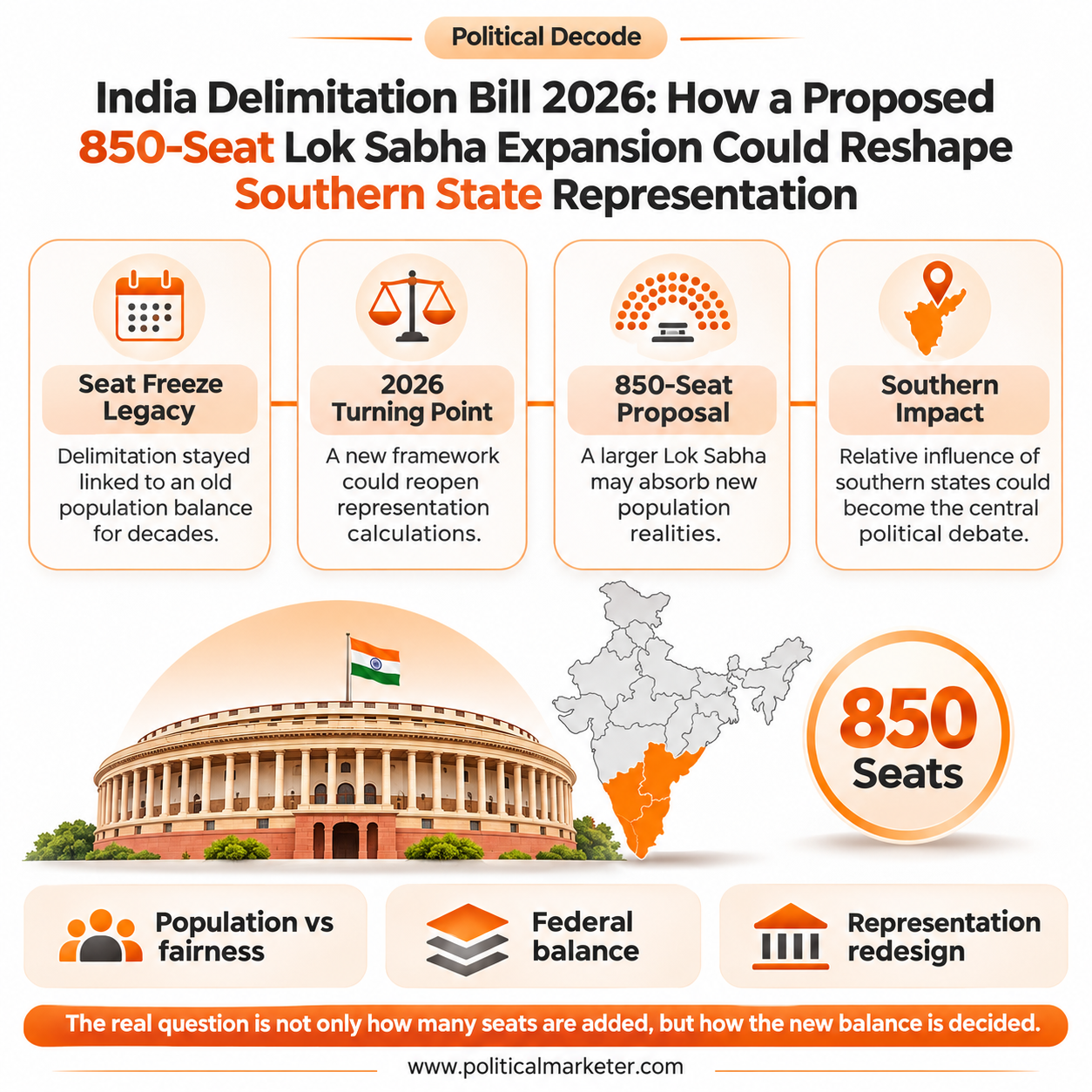
The revised November 2026 proposal is materially different from the package defeated in April. It provides for a 50% increase in seats for every state and Union Territory, protects the relative Lok Sabha representation of states until 2051, raises the constitutional Lok Sabha ceiling to 850, and links women's reservation to the first delimitation conducted after the amendment takes effect.
The proposal matters to voters, political parties, regional governments and the BJP-led NDA because it can change the number and boundaries of constituencies without shifting the existing relative share of states during the first exercise.
The November 2026 Delimitation Proposal Is Different From the April Bill
The current legislative plan centres on the Constitution (132nd Amendment) Bill, 2026 and the Delimitation (Second) Bill, 2026. The Union Cabinet cleared the revised package on November 27, 2026, after the Constitution (131st Amendment) Bill introduced in April failed to secure the required special majority in the Lok Sabha.
The revised proposal contains several major changes.
First, every state and Union Territory is to receive a 50% increase over its existing number of Lok Sabha seats during the first delimitation after the amendment begins. State and Union Territory Assemblies are also to receive a 50% increase, subject to revised constitutional ceilings.
Second, the proposal raises the maximum strength of the Lok Sabha from the existing constitutional ceiling of 550 to 850. The new ceiling provides for up to 815 members from states and 35 from Union Territories. The current Lok Sabha has 543 elected constituencies, so the constitutional ceiling of 850 should not automatically be treated as the exact final number of constituencies created by the first exercise. The 50% formula and the treatment of rounding will affect the final total.
Third, the maximum permitted size of a state Legislative Assembly would increase from 500 to 650.
Fourth, the relative distribution of Lok Sabha seats among states would remain protected until the relevant population figures from the first census after 2051 are published. This is a major response to objections from southern states that feared losing their national political share because of slower population growth.
Fifth, the Delimitation Commission would be constituted after the new law begins and would redraw constituencies using the latest census figures officially published at that point. If no newer census figures have been published by commencement, the 2011 Census would be the latest available dataset.
India's Delimitation History From 1952 to 2026
Delimitation has been part of India's electoral system since the early years of the Republic. Its basic purpose is to determine constituency boundaries and provide reasonably comparable representation based on population while respecting constitutional rules on seat allocation.
India has had four nationwide Delimitation Commissions under post-independence delimitation laws. They were constituted in 1952, 1963, 1973 and 2002. The Election Commission records these exercises under the Delimitation Commission Act, 1952, the Delimitation Commission Act, 1962, the Delimitation Act, 1972 and the Delimitation Act, 2002.
The early exercises adjusted parliamentary representation as India's population and political map changed.
The 1963 exercise increased the Lok Sabha's size after population growth raised the average number of residents represented by each constituency. The 1973 exercise again increased parliamentary representation.
A major constitutional change followed in 1976.
The 42nd Constitutional Amendment froze the allocation of Lok Sabha seats among states on the basis of the 1971 Census. The policy was intended to prevent states that had achieved greater population control from being politically penalised through a reduction in their relative parliamentary share.
The 84th Constitutional Amendment of 2001 extended the freeze until figures from the first census conducted after 2026 became available.
The 87th Constitutional Amendment later permitted constituency boundaries within states to be adjusted using 2001 Census figures without changing each state's overall Lok Sabha allocation.
The Delimitation Commission constituted in 2002 therefore worked with 2001 Census data. Its final orders were implemented for elections from 2008 onward. The present parliamentary constituency structure largely comes from that exercise.
India also conducted more recent delimitation exercises under special legal arrangements in areas including Jammu and Kashmir and Assam. Those exercises did not replace the nationwide freeze on redistribution of Lok Sabha seats among all states.
The next major constitutional link appeared in 2023.
The Constitution (106th Amendment) Act introduced reservation of one-third of Lok Sabha and state Assembly seats for women. Under the 2023 framework, the reservation was tied to delimitation following publication of figures from the first census after the amendment commenced. That linkage created uncertainty over whether the reservation could begin before the 2029 Lok Sabha election.
The government attempted to resolve that timing problem in April 2026.
What Happened to the First 2026 Delimitation Package
The April 2026 package contained the Constitution (131st Amendment) Bill, the Delimitation Bill and a related Union Territories legislation. The package proposed a larger Lok Sabha, a new delimitation process and earlier implementation of women's reservation.
The April proposal also reopened the principle of allocating seats among states according to population.
That created strong political resistance because population growth since 1971 has differed sharply across states. States that reduced fertility more quickly feared that a population-based redistribution would reduce their relative share of Lok Sabha representation compared with faster-growing states.
The Constitution (131st Amendment) Bill was voted on in the Lok Sabha on April 17, 2026.
A total of 298 MPs voted in favour and 230 voted against. With 528 members participating, the proposal needed 352 votes to achieve the required two-thirds support among members present and voting. It therefore fell 54 votes short. The related bills could not proceed after the constitutional amendment failed.
That defeat explains much of the structure of the November proposal.
The revised package writes the uniform 50% increase into the legal framework and extends protection for the existing inter-state balance until 2051. These were not equivalent safeguards in the text defeated in April.
How the New Delimitation Process Would Work
The revised process begins only after Parliament passes the required legislation and the constitutional amendment completes the legal approval process.
The constitutional amendment needs a majority of the total membership of each House and at least two-thirds of members present and voting. Because the proposed changes affect representation of states in Parliament, ratification by at least half of the state legislatures is also required.
After commencement, the Central Government would constitute a Delimitation Commission.
The revised Delimitation Bill provides for a commission chaired by a serving or former Supreme Court judge. Election authorities would also participate according to the statutory structure. The commission would determine constituency boundaries, seat allocation under the new rules and the identification of seats affected by reservation provisions.
The first exercise would increase seats in each state and Union Territory by 50%.
The boundaries of the expanded constituencies would then be drawn using the latest officially published census figures available when the legislation begins. This wording matters. The law does not permanently name the 2011 Census. If the amendment begins before newer census results are officially published, 2011 figures would be used. If newer figures are available first, the legal wording can point to those newer figures.
An unresolved technical question concerns rounding.
A state with an odd number of existing Lok Sabha seats cannot receive an exact 50% increase without producing a fractional number. For example, 39 multiplied by 1.5 produces 58.5. Public explanations have suggested possible rounding arrangements, but the final legal treatment must be settled through the legislation, rules or delimitation process.
Advantages of the Delimitation Bill 2026
The strongest argument for the revised proposal is that it increases representation without immediately transferring political weight from slower-growing states to faster-growing states.
A larger Lok Sabha can reduce the population represented by each MP. India's parliamentary constituencies have become much larger since the current seat allocation was fixed. More constituencies can give MPs smaller geographic or population responsibilities, which can improve direct contact between citizens and representatives.
The proposal also addresses the political problem created by the 1971 freeze.
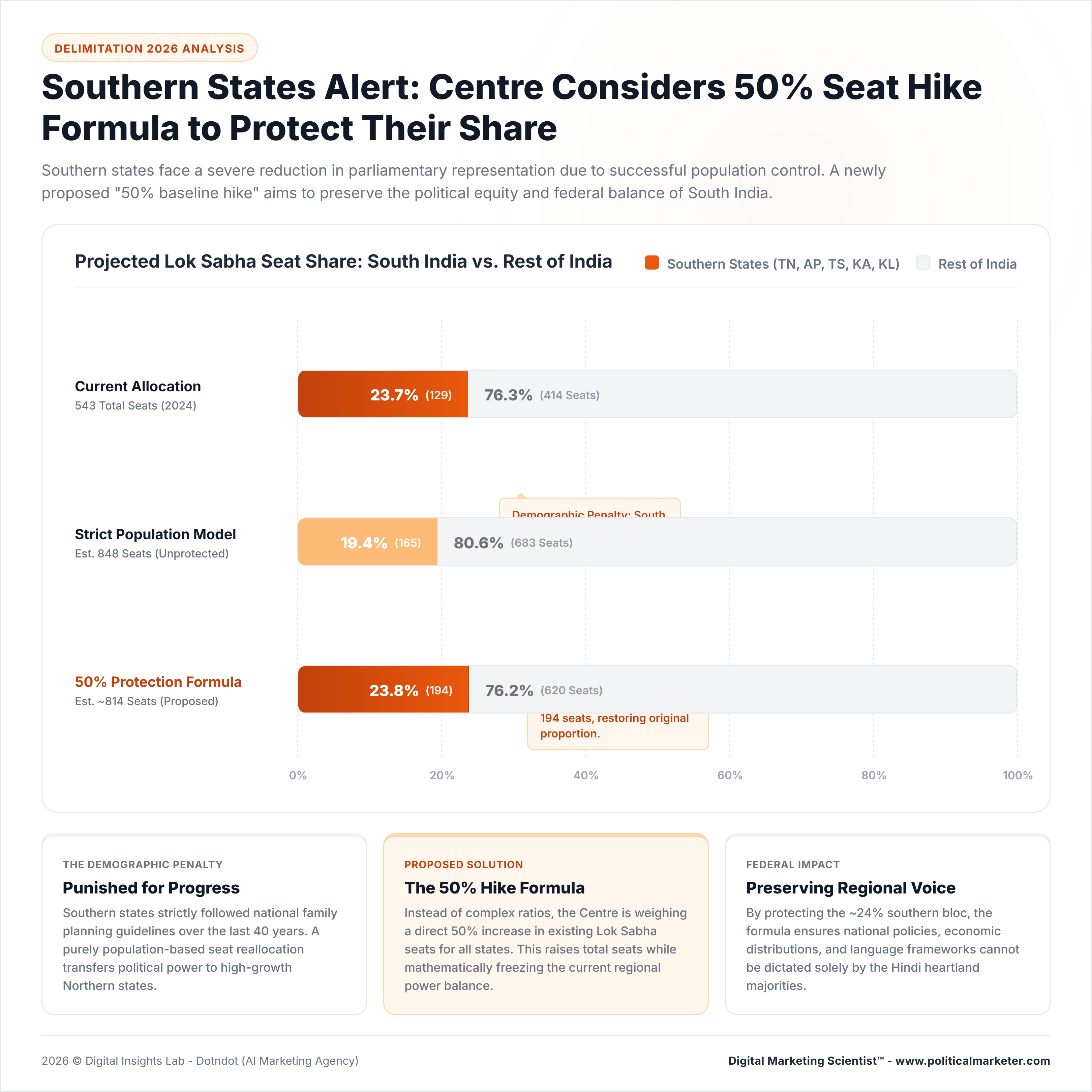
A purely population-based redistribution after the freeze expires would increase the share of several faster-growing states while reducing the relative weight of states with lower population growth. The 50% uniform increase allows every state to gain seats while preserving its existing relative position during the protected period.
Southern states therefore gain more seats without losing their present percentage share merely because they achieved lower population growth.
The proposal also creates hundreds of new opportunities for political participation. More parliamentary and Assembly seats mean more constituencies, more candidates and more elected positions. Supporters argue that this can create space for women, younger politicians, professionals, local leaders and people outside established political families.
Another major advantage is the earlier implementation of women's reservation.
The 2023 constitutional amendment created a one-third reservation but tied commencement to a future census and delimitation. The revised 2026 framework would permit the reservation to begin after the new delimitation exercise, with the government seeking implementation before the 2029 Lok Sabha election.
The enlarged House also reduces one political objection to women's reservation. If one-third of an unchanged 543-seat Lok Sabha were reserved, many sitting male MPs would face a smaller pool of unreserved constituencies. Expanding the total number of constituencies before applying the women's quota can create reserved seats while maintaining a larger number of constituencies overall.
Disadvantages and Constitutional Concerns
A larger Parliament creates operational and constitutional consequences that go beyond electoral boundaries.
One concern is the age of the population data.
If the legislation begins before the next census figures are published, constituency boundaries could be based on the 2011 Census. By the 2029 election, those numbers would describe a population distribution almost two decades old. Migration, urban growth, suburban expansion and population shifts since 2011 can make constituency equality harder to achieve.
Another concern is boundary design.
Preserving each state's relative national seat share does not prevent politically important changes inside a state. Constituencies still have to be redrawn. Urban areas can be divided differently, rural constituencies can be combined or separated, and reservation categories can change. Opposition parties therefore remain concerned that boundary decisions could alter electoral competitiveness even when the total seat share of a state is protected.
The legal independence and transparency of the Delimitation Commission will therefore receive close public scrutiny.
A larger Lok Sabha also changes the balance between the two Houses of Parliament.
Earlier legislative analysis calculated that if the elected Lok Sabha expanded from 543 to about 815 seats while the Rajya Sabha remained near its existing constitutional ceiling, the numerical weight of the Lok Sabha would rise substantially in a joint sitting.
The size of the Union Council of Ministers is another issue.
Article 75 limits the number of Union ministers to 15% of the total membership of the Lok Sabha. Earlier analysis estimated that a rise from 543 to 815 seats would raise the permissible ministerial ceiling from 81 to about 122. Expanding Parliament therefore indirectly increases the constitutional maximum size of the executive ministry unless the relevant rule is changed.
More MPs can also reduce the amount of parliamentary time available to each member.
Questions, debates, private member business and short interventions compete for limited sitting hours. Increasing the number of MPs without increasing parliamentary working time can reduce individual speaking opportunities.
The cost of elections and parliamentary operations would also increase. Hundreds of additional constituencies require election staff, polling arrangements, constituency offices, campaign organisations and administrative support.
Why the South India Question Became Central to the Revised Bill
The dispute over southern representation is one of the main reasons the November proposal differs from the April legislation.
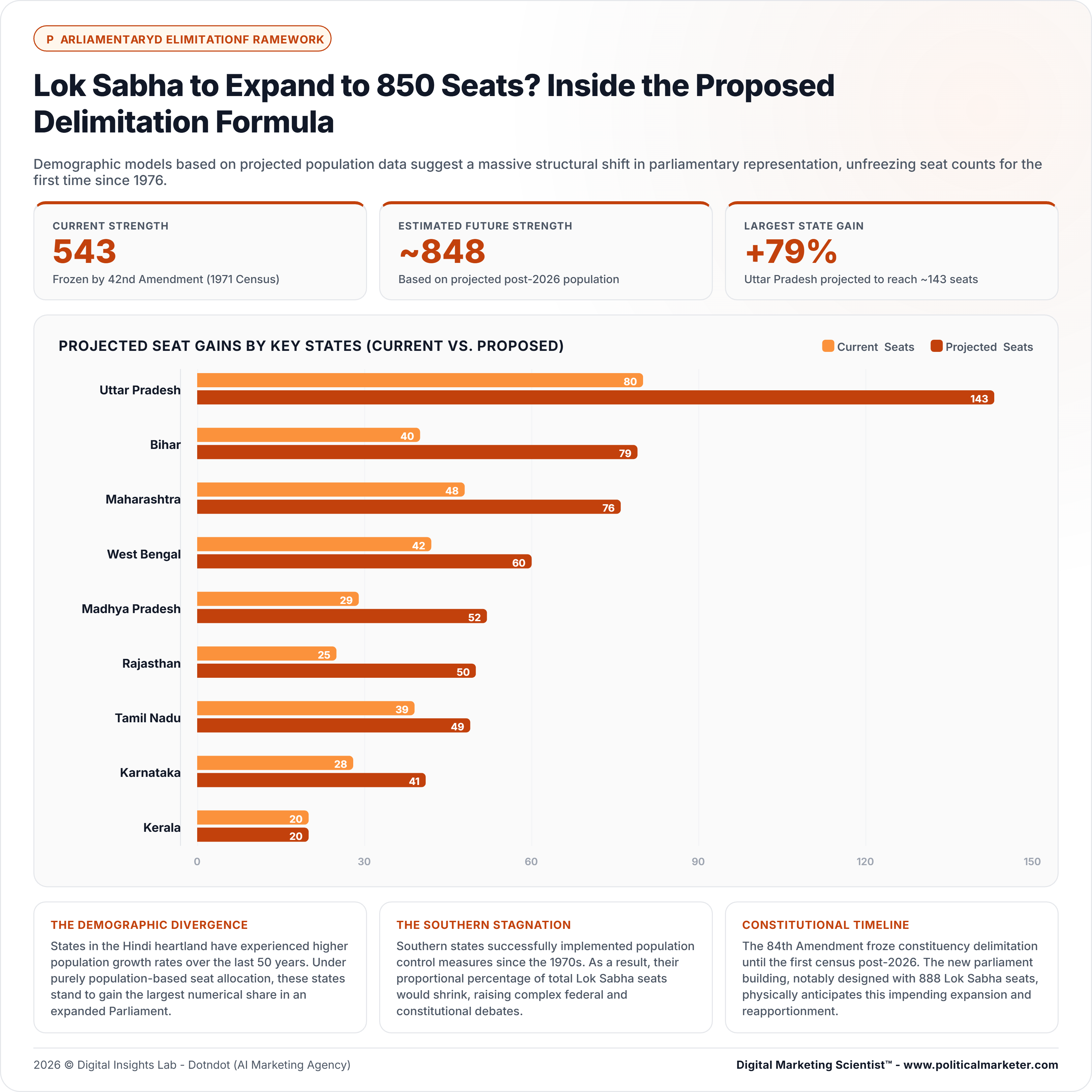
Tamil Nadu, Kerala, Karnataka, Andhra Pradesh and Telangana have experienced population trends different from several northern states. A direct redistribution based only on recent population totals could reduce the south's percentage share in the Lok Sabha even if its absolute number of seats increased.
Earlier population-based projections illustrated the scale of the concern.
Under one April-era calculation based on 2011 population and an enlarged House, faster-growing states such as Uttar Pradesh and Bihar would have gained substantially more representation, while the relative share of several southern states would have declined.
The November formula changes that calculation.
Every state receives the same proportional 50% increase, so the relative balance between states is broadly maintained. The proposal also extends the protection of inter-state representation until 2051.
This compromise has changed the political debate.
Regional parties that opposed the April approach because of possible losses in parliamentary weight have shown greater willingness to consider or support the November version. At the same time, opponents continue to raise concerns about constituency boundaries, the powers involved in conducting delimitation and the connection between seat expansion and women's reservation.
Women's Reservation Is the Main Legislative Driver
The revised delimitation package is directly connected to the one-third reservation for women approved through the Constitution (106th Amendment) Act, 2023.
Under the proposed Article 334A framework, women's reservation would take effect after the first delimitation undertaken following commencement of the new constitutional amendment.
The reservation covers one-third of seats in the Lok Sabha and relevant Legislative Assemblies. It also applies within seats reserved for Scheduled Castes and Scheduled Tribes according to the constitutional framework.
Reserved constituencies would rotate.
The Delimitation Commission would play a role in determining which constituencies are reserved, while the legal framework would govern rotation over time.
One less-discussed issue concerns the duration of the reservation.
The proposed wording retains a 15-year period measured from commencement of the Constitution (106th Amendment) Act, 2023, unless Parliament extends the period by law. If the quota begins several years after 2023, part of that 15-year period will already have elapsed before the first election is conducted under reservation.
That timing issue can become relevant during parliamentary debate.
Why the Delimitation Bill Matters So Much for BJP
The Delimitation Bill matters to the BJP for legislative, electoral and political reasons, but passage does not guarantee a BJP electoral advantage.
The first issue is parliamentary credibility.
The BJP-led government failed to pass the April constitutional amendment even though women's reservation and delimitation were major political projects. Passing a rewritten version would allow the government to show that it responded to regional concerns and assembled wider parliamentary support after the earlier defeat.
The second issue is women's representation.
If the revised package is enacted and the delimitation process is completed before 2029, the BJP can campaign on having moved the 2023 women's reservation from constitutional approval to actual electoral implementation.
That message can matter nationally because one-third reservation would change candidate selection for every major party.
The third issue is organisational scale.
An election involving hundreds of additional parliamentary constituencies requires candidate recruitment, booth structures, campaign workers, fundraising, voter data, communications operations and local leadership on a much larger scale. A party with extensive nationwide organisation can adapt more easily than a small party concentrated in a limited number of constituencies.
That does not mean additional seats automatically become BJP seats.
Every major party will receive additional constituencies in the states where it competes. Regional parties with strong local organisations can also gain from the expansion.
The fourth issue concerns southern politics.
The revised formula removes one of the strongest arguments against delimitation, the fear that southern states will lose relative representation because they controlled population growth. If the BJP can present the new formula as protection for the south, the delimitation debate becomes less focused on North versus South representation.
The fifth issue is candidate expansion.
A 50% increase in parliamentary and Assembly constituencies forces the BJP to develop a much larger candidate pool. That creates opportunity but also risk. Local factionalism, ticket competition and candidate quality become more difficult to manage when hundreds of new seats appear at the same time.
Why the Bill Also Creates Risks for BJP
Delimitation can create electoral uncertainty for the governing party as well as the opposition.
Existing BJP constituencies can be divided or redrawn. A safe constituency can become competitive if neighbourhoods, districts or demographic groups are rearranged. Sitting MPs can lose familiar political bases.
Women's reservation adds another layer.
Many sitting BJP MPs and MLAs could find their constituencies reserved for women. Parties will need to move incumbents, recruit women candidates or reorganise local leadership.
The expansion can also increase rebellion over nominations.
If parties have more seats, they have more tickets to distribute, but they also create more competing local centres of power. Aspirants who lose nominations can defect, campaign against official candidates or create internal disputes.
The 2051 freeze also limits a possible BJP advantage from faster population growth in parts of northern India.
A pure post-2026 population formula might have shifted a larger share of Lok Sabha seats toward states such as Uttar Pradesh and Bihar. The uniform 50% formula gives these states more seats but does not increase their percentage share relative to states such as Tamil Nadu or Kerala during the protected period.
The revised proposal is therefore not simply a mechanism that transfers parliamentary power toward BJP-dominated northern states.
How the New Map Could Affect the 2029 Lok Sabha Election
The 2029 election could be India's first general election conducted with a much larger Lok Sabha and one-third women's reservation, but only if several legal and administrative stages are completed on time.
Passage by Parliament is the first hurdle.
The constitutional amendment requires a special majority in both Houses. The April bill demonstrated that the NDA cannot treat the vote as automatic. Support from parties outside the governing alliance can determine the result.
State ratification is another stage.
At least half of the states would need to ratify the amendment because the proposal affects representation of states in Parliament.
The Delimitation Commission would then have to complete one of the largest constituency redesign exercises in Indian history.
Draft boundaries, objections, hearings, final orders, reservation of seats and election preparation would all have to occur before the Election Commission can conduct a general election under the new map.
Government sources have indicated an objective of completing the process within roughly two years so that the new arrangements can operate before 2029. That is a policy target, not a completed outcome.
Future Political Predictions After Delimitation
The most defensible predictions are scenario-based because the legislation has not yet completed Parliament, state ratification or the delimitation process.
If the revised bills pass, the 2029 election is likely to involve the largest restructuring of parliamentary competition in decades.
Political parties will need to redraw organisational districts, appoint new constituency coordinators, identify candidates earlier and build booth organisations across newly created seats.
Women candidates will become central to candidate planning.
Parties that begin identifying and developing women leaders before the final reservation map is published will have more options when one-third of constituencies become reserved.
Regional parties are likely to remain powerful.
The 50% uniform formula protects state-wise proportional representation until 2051. That means seat expansion does not automatically shift national power from southern or eastern regional parties toward northern states.
Candidate selection will become less predictable.
New constituencies often lack long electoral histories. Historical vote-share models based on existing constituencies will need to be reconstructed using booth-level and Assembly-segment data.
Urban politics can gain greater weight.
Fast-growing cities currently contain some of India's most populous constituencies. Creating more seats within major urban regions can increase the number of MPs representing metropolitan voters, although the exact effect depends on the census data and final boundaries used by the commission.
The BJP can gain from organisational capacity, but opposition parties can gain from fragmentation of existing seats.
If an opposition party has concentrated support inside part of a large constituency, a new boundary can create a seat where that support becomes more competitive. The same principle can work for the BJP.
The 2029 result therefore cannot be predicted simply by applying current party vote shares to a larger number of constituencies.
The Bigger Constitutional Effect Goes Beyond 2029
The long-term significance of the revised delimitation package extends beyond a single general election.
A much larger Lok Sabha changes how Parliament works.
The relationship between Lok Sabha and Rajya Sabha changes numerically. The potential size of the Union Council of Ministers changes. Parliamentary time has to be shared among more members. Political parties require larger parliamentary organisations and more committee assignments.
State politics also changes because Assembly seats would expand by 50%.
That means delimitation affects not only national politics but candidate recruitment, cabinet formation, constituency service and party organisation at state level.
The proposed 2051 protection is equally significant.
India would postpone another major redistribution of relative parliamentary representation for roughly a quarter century. Population differences between states would continue, but those differences would not immediately change each state's proportional Lok Sabha weight.
A future post-2051 exercise could reopen the same federal debate on a much larger scale.
What Happens Next
The immediate stage is Parliament's special sitting beginning November 30, 2026. The Lok Sabha is scheduled to reconvene first, with the Rajya Sabha meeting from December 2.
The government must secure the special majority required for the constitutional amendment.
The political position is different from April because some regional parties that objected to population-based redistribution have responded more positively to the 50% uniform increase and 2051 protection. Opposition parties remain divided over whether those safeguards sufficiently address their concerns.
If Parliament passes the amendment, state ratification becomes the next constitutional stage.
If the required ratifications are secured, the new legal framework can commence and the Delimitation Commission can begin work.
Only after the commission completes its exercise will India know the exact final number of Lok Sabha constituencies, the exact boundaries of the new seats, the distribution of SC and ST reserved constituencies, the seats reserved for women and the practical electoral map for 2029.
The central issue is therefore no longer simply whether India should conduct delimitation after 2026.
The debate has moved to how India can increase representation, introduce women's reservation, maintain federal balance, use population data fairly and redraw hundreds of constituencies without creating unacceptable political distortions.
The Constitution (132nd Amendment) Bill and Delimitation (Second) Bill attempt to answer those competing demands through a uniform 50% expansion and a 2051 protection for state-wise representation. Whether that formula survives Parliament, state ratification and the delimitation process will determine whether the 2029 Lok Sabha election is fought on India's current electoral map or on a substantially larger one.
The Delimitation Bill 2026 could produce one of the biggest changes to India’s electoral system in decades. The revised proposal seeks to increase Lok Sabha and Assembly representation by 50%, protect the relative parliamentary share of states until 2051, and make the 33% reservation for women operational before the 2029 general election. Its importance therefore extends beyond drawing new constituency boundaries. It affects federal representation, candidate selection, parliamentary functioning, regional politics and future election strategy.
For the BJP, the proposal offers both opportunity and risk. A larger electoral map can reward parties with strong organisation, candidate networks and campaign resources, while women’s reservation can give the government a major political message ahead of 2029. At the same time, redrawn constituencies, new reserved seats, ticket competition and stronger regional-party opportunities can make many existing political calculations less reliable.
The final political impact cannot be predicted until Parliament decides the legislation, the required state ratifications are completed and the Delimitation Commission publishes the new constituency map. If the process is completed before 2029, parties will have to rebuild electoral strategies around hundreds of new seats and a much larger pool of women candidates. Delimitation could therefore reshape not only the 2029 Lok Sabha election, but the structure of Indian electoral politics for several decades.
Delimitation Bill: FAQs
The Delimitation Bill 2026 is part of a legislative proposal to redraw electoral constituencies, increase the number of Lok Sabha and state Assembly seats, and support implementation of the 33% reservation for women. The revised November 2026 proposal provides for a 50% increase in seats while protecting the relative parliamentary share of states until 2051.
The revised proposal raises the constitutional ceiling of the Lok Sabha to 850 seats, including up to 815 seats for states and 35 for Union Territories. The exact final number of constituencies will depend on the delimitation process, the 50% expansion formula and the treatment of rounding.
If the legislation is passed and the delimitation process is completed in time, the 2029 Lok Sabha election could be conducted with a much larger number of constituencies and with one-third of seats reserved for women. Political parties would need to reorganize candidates, constituency structures and campaign operations around the new electoral map.
The revised proposal gives every state and Union Territory a 50% increase in seats while keeping the relative distribution of Lok Sabha representation among states protected until 2051. This reduces concerns that states with slower population growth could immediately lose political weight to faster-growing states.
The main advantages include more representatives for a larger population, smaller voter populations per constituency, more opportunities for women and new political candidates, protection of the relative representation of states and possible implementation of the 33% women's reservation before the 2029 election.
Concerns include the possible use of older census data, disputes over constituency boundaries, higher election and parliamentary costs, reduced speaking time for individual MPs, changes to the numerical relationship between the Lok Sabha and Rajya Sabha, and political uncertainty created by redrawing existing constituencies.
The bill is important for the BJP because passing it would allow the BJP-led government to advance seat expansion and women's reservation before 2029. The BJP's nationwide organisational structure could help it manage a larger number of constituencies, but new boundaries, reservation changes and candidate competition could also create electoral risks.
No. A larger number of constituencies does not automatically translate into more BJP victories. Redrawn boundaries can help or hurt any party depending on local voting patterns. Regional parties, Congress and other opposition parties can also benefit from newly created seats where their support is concentrated.
The Constitution (106th Amendment) Act, 2023 provides for reservation of one-third of Lok Sabha and state Assembly seats for women. The reservation is linked to a delimitation exercise. The revised 2026 proposal is intended to make that process possible before the 2029 general election if all legal and administrative stages are completed.
The constitutional amendment must first secure the required special majority in Parliament. State ratification is also required because the proposal affects representation of states in Parliament. After that, a Delimitation Commission must be constituted, constituency boundaries must be prepared and finalized, and reserved seats must be identified before elections can be conducted under the new map.