


ECINET (Election Commission of India Network) represents a landmark transformation in how electoral services are designed, delivered, and governed in India. Conceived and implemented by the Election Commission of India, ECINET is a unified digital gateway that brings together more than 40 electoral applications and portals into a single, integrated platform.
Its core objective is to simplify access to electoral services while ensuring scalability, reliability, and institutional integrity in a democracy serving over a billion citizens.
By consolidating fragmented digital systems into a single, coherent ecosystem, ECINET establishes a standardized, citizen-centric interface for electoral participation and administration nationwide.
At a structural level, ECINET operates as a national public digital infrastructure for elections. It connects voters, election officials, and institutional stakeholders through a common digital backbone that supports multilingual access, real-time data exchange, and secure workflows.
With support for 23 languages, ECINET ensures inclusivity and accessibility, allowing citizens from diverse linguistic and regional backgrounds to engage with electoral processes without barriers.
One of ECINET’s most significant contributions is its ability to improve operational efficiency significantly.
Processes that previously took weeks or months, such as index card publication or large-scale data consolidation, now take hours or days.
Real-time reporting capabilities enable faster decision-making, improved oversight, and more responsive electoral management.
This shift from delayed, manual workflows to digital, near-instant systems marks a fundamental change in how elections are administered at scale in India.
ECINET also plays a critical role in strengthening transparency and public accountability.
By enabling real-time disclosure of key electoral information and providing citizens with direct access to services such as voter registration, electoral roll search, grievance redressal, and application tracking, the platform reduces dependency on intermediaries.
Citizens can verify information, monitor application status, and raise concerns through authenticated digital channels, reinforcing trust in the electoral system and improving institutional credibility.
From an administrative perspective, ECINET connects a vast electoral machinery that spans booth-level officers, polling officials, and district and state election authorities.
This end-to-end connectivity ensures consistency in data, standardized procedures, and coordinated execution across all levels of election management.
Election officials benefit from centralized dashboards, streamlined communication, and integrated reporting tools, which collectively enhance preparedness, compliance, and operational control during electoral cycles.
Security and data protection form another foundational pillar of ECINET’s design.
Given the sensitivity and scale of electoral data, the platform incorporates robust cybersecurity measures to safeguard information integrity, prevent unauthorized access, and ensure system resilience.
These protections are essential not only for operational continuity but also for maintaining public confidence in digital electoral systems.
ECINET reflects India’s evolving approach to digital governance, where technology is leveraged as a public good rather than a standalone service.
By aligning efficiency, transparency, inclusivity, and security within a single platform, ECINET sets a benchmark for how democratic institutions can modernize without compromising constitutional values.
As the world’s largest electoral service platform, it stands as a reference model for other democracies seeking to build scalable, trusted, and citizen-focused electoral infrastructure.
Key Scale Metrics of ECINET (Election Commission of India Network)
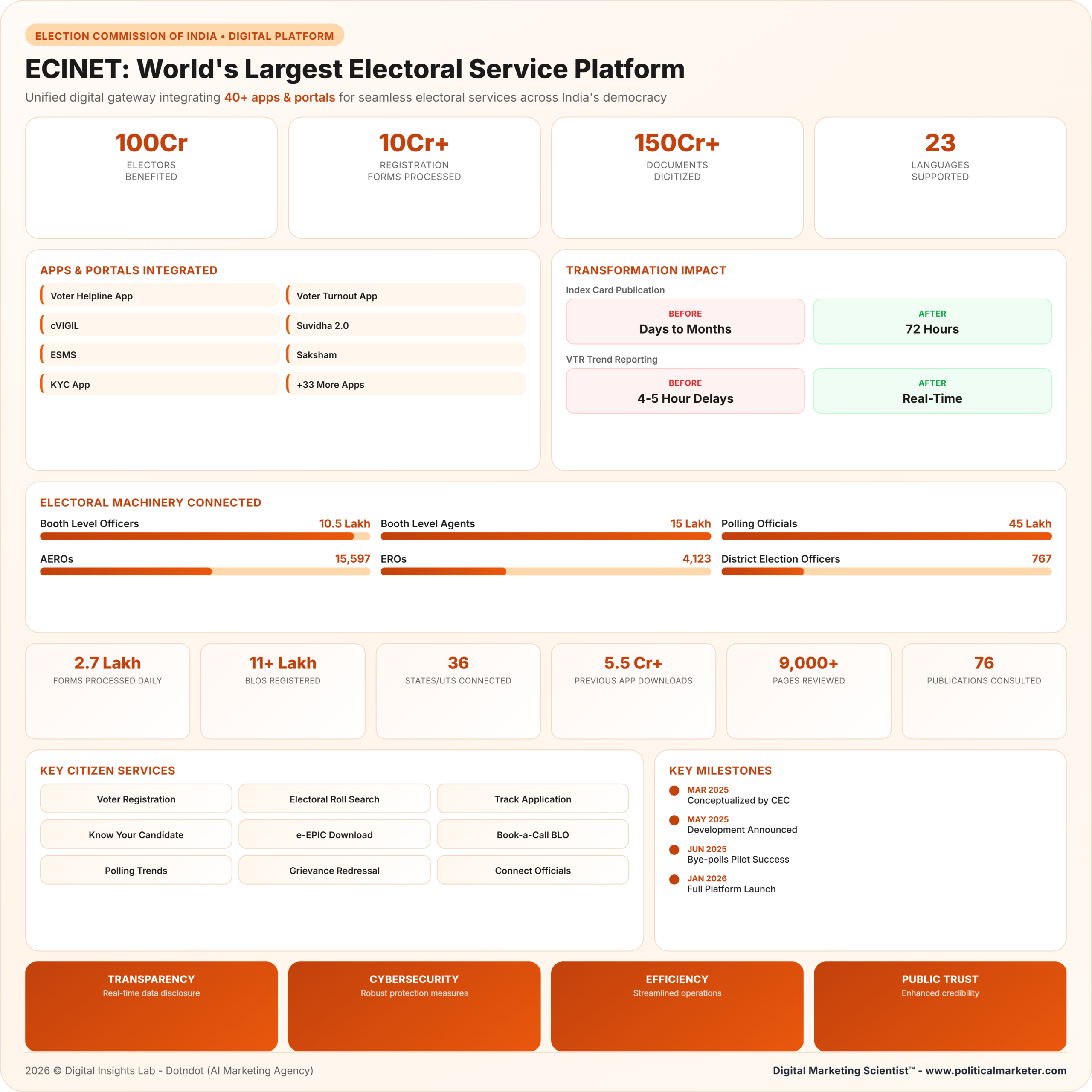
ECINET operates at an unprecedented national scale, serving over 100 crore electors through a single unified digital platform.
It has processed more than 10 crore voter registrations and related forms, while digitizing over 150 crore electoral documents to enable faster access, greater accuracy, and greater transparency.
With support for 23 languages, the platform ensures inclusive participation across India’s diverse linguistic landscape, making electoral services accessible to citizens and officials at every level of the democratic process.
Overview of Scale and Reach
ECINET operates at a national scale that matches the size and complexity of India’s democracy.
When you use the platform, you interact with a system designed to serve over 100 crore electors through a single unified digital interface.
This scale reflects the platform’s role as a central access point for electoral services, rather than a collection of disconnected applications. The numbers below describe the operational load ECINET handles continuously and explain why it functions as a core public digital system for elections.
Electors Benefited
ECINET supports electoral services for more than 100 crore electors across the country.
This means you can access voter services regardless of your location, constituency, or state, using the same standardized digital framework.
The figure indicates national coverage across urban, rural, and remote regions. This claim relates to registered electors on the electoral rolls and requires official Election Commission data for verification in formal publications.
Registration Forms Processed
The platform has processed over 10 crore registrations and related electoral forms.
These include new voter registrations, corrections, address changes, and deletions.
By handling these volumes digitally, ECINET reduces processing time and reliance on manual labor.
For you, this translates into faster acknowledgements, more precise tracking, and fewer delays. This metric depends on cumulative administrative records and should be cited from official ECINET or Election Commission disclosures.
Documents Digitized
ECINET has digitized more than 150 crore electoral documents. These records include voter details, roll updates, verification documents, and administrative files.
Digitization allows election officials to verify data quickly and maintain consistency across states and districts. For you, it improves accuracy and reduces errors that often arise from paper-based systems. This claim requires citation from official digitization and archival reports.
Languages Supported
The platform supports 23 languages to ensure you can access electoral services in your preferred language. Multilingual support reduces entry barriers and improves participation across regions with different linguistic needs. This feature is essential for nationwide adoption and usability.
The 23 languages supported are:
- Assamese
- Bengali
- Bodo
- Dogri
- English
- Gujarati
- Hindi
- Kannada
- Kashmiri
- Konkani
- Maithili
- Malayalam
- Manipuri
- Marathi
- Nepali
- Odia
- Punjabi
- Sanskrit
- Santali
- Sindhi
- Tamil
- Telugu
- Urdu
Language support details should be verified against official ECINET documentation, as language availability can expand over time.
Apps and Portals Integrated Within ECINET
ECINET brings together more than 40 electoral apps and portals into a single, unified system, eliminating the need to navigate multiple disconnected platforms.
Core applications such as the Voter Helpline App, cVIGIL, ESMS, KYC App, Voter Turnout App, Suvidha 2.0, and Saksham operate within a single digital framework, alongside 33 additional electoral tools.
This integration ensures consistent data, smoother workflows, and a simpler experience for both citizens and election officials, while maintaining centralized control and real-time coordination across the entire electoral process.
Integrated Application Framework
ECINET brings more than 40 electoral apps and portals into a single national system. When you use ECINET, you no longer need to move between separate platforms for different electoral tasks.
Each application operates within a shared digital framework that uses common data standards, unified authentication, and synchronized workflows.
This structure reduces duplication, prevents data mismatches, and improves coordination across election operations at every level.
Core Citizen-Facing Applications
Several well-known electoral apps form the public-facing layer of ECINET. These tools allow you to access services directly without intermediaries.
- Voter Helpline App
- You can register to vote, update details, search the electoral roll, and download your e-EPIC.
- ESMS
- Election officials use this system to manage and report election results during polls.
- KYC App
- Officials use this app to verify voter identities and conduct checks during field operations.
- Voter Turnout App
- You can view turnout data reported from polling stations in near-real time.
- Suvidha 2.0
- Political parties and candidates use this portal to request permissions, file submissions, and track approvals.
- Saksham
- This application supports accessible electoral services, especially for persons with disabilities and senior citizens.
Each of these apps retains its functional role while operating within ECINET’s shared infrastructure.
Administrative and Back-End Applications
Beyond public-facing tools, ECINET integrates a large set of internal and administrative applications used by election officials.
These systems manage electoral rolls, polling logistics, personnel deployment, observer coordination, expenditure monitoring, grievance handling, and reporting.
Integration ensures that when officials update data in one system, related systems reflect the change without manual transfers.
About the “+33 More Apps”
The remaining 33 applications are not publicly listed as a single official catalogue in publicly available materials. They typically fall into the following categories:
- Electoral roll management and revision systems
- Polling personnel deployment tools
- Observer reporting platforms
- Expenditure monitoring systems
- Grievance tracking portals
- Training and capacity-building platforms
- Results dissemination and reporting tools
- Logistics and warehouse management systems
For accuracy, any formal publication should cite official Election Commission of India documentation or the ECINET platform release notes to enumerate these applications by name.
Voter Helpline
Android App URL: https://play.google.com/store/apps/details?id=com.eci.citizen
Apple Store App URL: https://apps.apple.com/in/app/voter-helpline/id1456535004
This app provides voters with access to electoral roll search, voter registration and modification, form submission tracking, candidate details, polling official contact information, election schedules, FAQs, and complaint registration with status tracking.
ECINET
Android App URL: https://play.google.com/store/apps/details?id=in.gov.eci.app
Apple Store App URL: https://apps.apple.com/in/app/ecinet/id6745955212
ECINET serves as a unified election services platform that integrates multiple election-related tools. It enables voter registration, access to the electoral roll, polling station details, and real-time election updates, along with secure, role-based access for officials.
BLOApp
Android App URL: https://play.google.com/store/apps/details?id=in.gov.eci.bloapp
Apple Store App URL: https://apps.apple.com/in/app/bloapp-eci/id6449996333
This app supports Booth Level Officers in field operations, including house-to-house verification, checklist management, and data collection for electoral roll updates.
cVIGIL
Android App URL: https://play.google.com/store/apps/details?id=in.nic.eci.cvigil
Citizens can use this app to report election-related violations, including Model Code of Conduct breaches. Reports include time-stamped photos or videos with location data.
cVIGIL Investigator
Android App URL: https://play.google.com/store/apps/details?id=in.gov.eci.cvigil.squad
This app allows authorized officials to review, verify, and act on violation reports submitted through the CVIGIL system.
Saksham-ECI
Android App URL: https://play.google.com/store/apps/details?id=pwd.eci.com.pwdapp
Apple Store App URL: https://apps.apple.com/in/app/saksham-eci/id1497864568
This app supports voters with disabilities by enabling voter registration, polling station discovery, and access to accessibility-focused electoral services.
EMS 2.0
Android App URL: https://play.google.com/store/apps/details?id=org.ecil.ems.app
Apple Store App URL: https://apps.apple.com/in/app/esms/id6466198820
EMS 2.0 supports internal election workflows, including field reporting, monitoring, and operational data capture, for election management teams.
ERONET App
Android App URL: https://play.google.com/store/apps/details?id=in.gov.eci.eronet
This app assists election officials with electoral roll management, including updates, deletions, and verification activities.
ECI Observer
Android App URL: https://play.google.com/store/apps/details?id=in.nic.eci.observer
Designed for election observers, this app enables structured reporting, observation tracking, and oversight during election operations.
Suvidha 2.0
Android App URL: https://play.google.com/store/apps/details?id=suvidha.eci.gov.in.candidateapp
This app supports candidates and political parties by allowing submission and tracking of nominations, permissions, and election-related requests.
EMS APP
Android App URL: https://play.google.com/store/apps/details?id=in.gov.eci.ems
This application functions as an additional module within the electronic management system used by election officials for operational coordination.
cVIGIL Monitor
Android App URL: https://play.google.com/store/apps/details?id=in.gov.eci.cvigil.monitor
Apple Store App URL: https://apps.apple.com/in/app/cvigil-monitor/id1509016464
This app enables officials to monitor incoming violation reports and track case progress within the CVIGIL framework.
Voter Turnout
Android App URL: https://play.google.com/store/apps/details?id=in.gov.eci.pollturnout
Apple Store App URL: https://apps.apple.com/in/app/voter-turnout-app/id1536366882
This app displays voter turnout data during elections, allowing the public and officials to view participation levels by constituency.
KYC-ECI
Android App URL: https://play.google.com/store/apps/details?id=com.eci.ksa
Apple Store App URL: https://apps.apple.com/in/app/kyc-eci/id1604172836
This app supports verification workflows related to candidate and electoral data, helping ensure accuracy and compliance.
cVIGIL Decider
Android App URL: https://play.google.com/store/apps/details?id=in.gov.eci.cvigil.decider
Apple Store App URL: https://apps.apple.com/in/app/cvigil/id1455719541
Senior officials use this app to review, decide, and close cases reported through the CVIGIL system.
Encore Nodal
Android App URL: https://play.google.com/store/apps/details?id=suvidha.eci.gov.in.nodalofficerapp
This app supports nodal officers in coordinating specific election-related workflows and administrative tasks.
Ways to the Election Commission of India Network (ECINET)
Ways to Election Commission of India Network (ECINET) explains how citizens, election officials, and administrators can use ECINET to access electoral services, manage election operations, and engage with the election process through a single digital platform.
It covers practical ways to use ECINET for voter registration, electoral roll verification, application tracking, grievance redressal, polling trend monitoring, and coordination with election officials.
The focus is on how ECINET simplifies participation, improves transparency, and supports large-scale election management across India through standardized digital workflows.
| Area of Use | Ways to Use ECINET |
|---|---|
| Voter Registration | Apply for new voter registration, update personal details, request corrections, or submit deletion requests through a single digital interface. |
| Electoral Roll Verification | Search your name in the electoral roll, verify constituency details, and identify errors before election deadlines. |
| Application Tracking | Track the status of voter registration and modification requests with clear stage-wise updates. |
| Digital Identity Access | Download and use the electronic Elector Photo Identity Card (e-EPIC) after verification. |
| Candidate Information | Access verified candidate details for your constituency using official election data. |
| Polling Trends Monitoring | View near-real-time voter turnout trends during polling periods to raise public awareness. |
| Grievance Redressal | Submit election-related complaints and monitor resolution progress through structured digital workflows. |
| Booth Level Officer Interaction | Schedule calls or connect digitally with your Booth Level Officer for guidance and verification support. |
| Election Code Violation Reporting | Report Model Code of Conduct violations using integrated tools such as cVIGIL within the ECINET framework. |
| Election Official Coordination | Enable centralized dashboards, reporting tools, and communication channels for election officials at all levels. |
| Electoral Roll Management | Support roll revision, verification, and approval processes for election officers. |
| Workforce Deployment | Coordinate polling staff, observers, and election personnel through standardized digital systems. |
| Real-Time Reporting | Share and access operational reports, turnout data, and field updates without manual consolidation delays. |
| Multilingual Access | Use electoral services in any of the 23 supported Indian languages for inclusive participation. |
| Nationwide Standardization | Experience consistent electoral services and procedures across all states and Union Territories. |
Transformation Impact of ECINET
ECINET has significantly reduced time delays in critical electoral processes by shifting them to a unified digital system.
Index card publication, which earlier required days or even months, now completes within 72 hours through centralized workflows and standardized data handling. Similarly, voter turnout trend reporting has moved from delays of four to five hours to real-time visibility, allowing you and election officials to access up-to-date information without waiting for manual consolidation.
These changes demonstrate how ECINET improves speed, accuracy, and responsiveness across election operations.
Overview of Operational Change
ECINET has changed how you experience time-sensitive electoral processes by replacing fragmented manual workflows with a unified digital system. The platform focuses on reducing delays, improving data consistency, and giving you faster access to verified electoral information.
Two areas clearly show this change: index-card publication and reporting of voter turnout trends. These improvements reflect measurable shifts in speed and coordination rather than abstract system upgrades.
Index Card Publication
Before ECINET, index card publication involved multiple approval layers, physical record movement, and repeated verification cycles.
These steps stretched timelines from several days to, in some cases, months. You often had to wait while officials consolidated data across offices.
With ECINET, election authorities publish index cards within 72 hours. Centralized data entry, shared validation rules, and synchronized access across departments remove manual handoffs.
When you submit or verify electoral details, the system processes updates more quickly and reflects them across connected services without requiring repeated manual intervention.
Claims about reduced timelines rely on official Election Commission process records and internal workflow benchmarks. Any public reporting should reference these sources for validation.
Voter Turnout Trend Reporting
Previously, voter turnout trend reporting relied on staggered polling-station reporting. Officials collected data manually, compiled it at multiple levels, and released updates every four to five hours. During this gap, you had limited visibility into turnout trends.
ECINET enables near real-time turnout reporting by connecting polling-level data directly to centralized dashboards.
As officials submit turnout figures, the system updates aggregated views in real time. You can access current turnout trends as they emerge, improving transparency and reducing uncertainty during polling hours.
This shift depends on live data submission protocols and network connectivity standards defined by the Election Commission.
Any formal publication should cite official turnout reporting guidelines to support these claims.
Electoral Machinery Connected Through ECINET
ECINET digitally connects the full electoral workforce, from booth-level officers and agents to district and state election authorities, within a single coordinated system.
The platform links over 10.5 lakh booth-level officers, 15 lakh booth-level agents, and 45 lakh polling officials with more than 15,000 assistant electoral registration officers, 4,000 electoral registration officers, and 767 district election officers.
This end-to-end connectivity ensures consistent data flow, clearer communication, and faster coordination across all levels of election administration, delivering smoother, more reliable electoral services.
Overview of Workforce Integration
ECINET connects the entire electoral workforce through a single digital system that you rely on during every stage of an election. Instead of working in isolated administrative layers, election personnel operate on a shared platform with consistent data and standardized processes.
This approach improves coordination, reduces reporting delays, and gives you clearer visibility into how elections are managed on the ground.
Booth Level Officers
ECINET connects over 10.5 lakh Booth Level Officers who handle voter verification, registration support, and field-level updates. When a Booth Level Officer verifies or updates voter information, the system records and shares the data across connected applications.
This reduces manual data entry and ensures your voter records reflect the latest, verified details. These figures come from official electoral workforce records and should be cited from Election Commission publications when used in formal reports.
Booth Level Agents
More than 15 lakh Booth Level Agents operate within the ECINET framework. These agents support party-level and candidate-level oversight at polling locations. Through digital connectivity, agents submit reports, observe processes, and communicate issues using standardized channels.
For you, this improves consistency and reduces disputes that often arise from delayed or incomplete reporting. Workforce counts require citation from official election deployment data.
Polling Officials
ECINET supports the coordination of over 45 lakh polling officials involved in voting day operations. These officials manage polling stations, voter identification, ballot procedures, and turnout reporting. The platform enables structured data submission and faster e-issue escalation. When polling officials report figures or incidents, ECINET updates central dashboards without manual consolidation, improving response time and accuracy.
Assistant Electoral Registration Officers
The platform connects 15,597 Assistant Electoral Registration Officers who oversee voter registration processes at the sub-district level. You benefit from faster application review and approval because AEROs have access to centralized records and shared verification tools. This reduces backlogs and improves accountability. Officer counts should be validated against official administrative staffing records.
Electoral Registration Officers
ECINET links 4,123 Electoral Registration Officers responsible for maintaining electoral rolls. These officers use the platform to approve changes, manage revisions, and monitor compliance. Centralized access helps them track actions across jurisdictions, which improves data consistency for you as a voter. These figures depend on the Election Commission’s official staffing disclosures.
District Election Officers
At the district level, ECINET connects 767 District Election Officers who coordinate election planning and execution. They use integrated dashboards to monitor field activity, personnel deployment, and reporting status. This visibility helps resolve issues faster and ensures consistent application of election procedures across districts. District officer counts require confirmation from official district-wise administrative data.
Operational Metrics of ECINET
ECINET manages high-volume electoral operations daily through a centralized digital system. The platform processes approximately 2.7 lakh forms per day, reflecting ongoing citizen engagement and administrative activity. It supports more than 11 lakh registered Booth Level Officers and connects all 36 States and Union Territories within a single operational framework. With over 5.5 crore downloads across earlier electoral apps, along with reviews of more than 9,000 pages and consultations of 76 official publications, these metrics demonstrate how ECINET sustains large-scale, coordinated, and data-driven election management across the country.
Overview of Daily Operations
ECINET manages continuous, high-volume electoral activity nationwide through a single digital operating system. These metrics show how the platform supports you and election officials every day, not only during election periods. The numbers reflect routine usage, system load, and nationwide coordination rather than one-time deployments.
Forms Processed Each Day
ECINET processes around 2.7 lakh electoral forms daily. These include voter registrations, corrections, deletions, and address updates. When you submit a request, the platform routes it through standardized digital workflows instead of manual paper trails. This reduces processing delays and improves tracking. Daily processing volumes should be validated using official Election Commission operational dashboards or, when publicly cited, periodic performance reports.
Registered Booth Level Officers
The platform supports more than 11 lakh registered Booth Level Officers. These officers form the field-level backbone of electoral administration and handle voter verification and local updates. ECINET connects your field activity directly to central systems, so your voter information updates faster and with fewer errors. Officer registration figures are based on official workforce deployment data and must be cited in formal documentation.
Nationwide Coverage Across States and Union Territories
ECINET connects all 36 States and Union Territories under a single operational framework. This nationwide coverage ensures you receive the same service standards wherever you are. Data formats, approval flows, and reporting rules remain consistent across regions, which reduces administrative variation and confusion during electoral processes.
Previous App Downloads
Earlier electoral apps linked to ECINET recorded more than 5.5 crore downloads. This figure shows widespread public adoption of digital electoral services before platform consolidation. ECINET builds on this existing usage base by consolidating these services into a single system, so you no longer need to switch between multiple applications. Download statistics should be referenced from official app store analytics or Election Commission disclosures.
Pages Reviewed During Platform Development
The ECINET program involved reviewing over 9,000 pages of material. These pages include legal provisions, procedural manuals, technical documents, and operational guidelines. This review ensures that digital workflows reflect statutory requirements and established election practices. Claims about documentation volume should reference internal project records or official summaries.
Publications Consulted
The development and integration process consulted 76 official publications. These publications cover election laws, procedural instructions, manuals, and historical guidance. By grounding system design in documented rules, ECINET ensures that digital processes match regulatory expectations. Publication counts should be supported by official project documentation when cited.
Key Citizen Services Offered Through ECINET
ECINET integrates essential electoral services into a single, citizen-accessible digital system. You can register as a voter, search the electoral roll, track application status, and download your e-EPIC without visiting multiple offices. The platform also lets you view candidate information, monitor polling trends, raise grievances, and connect with election officials or your Booth Level Officer through scheduled calls. By centralizing these services, ECINET reduces delays, improves transparency, and gives you clearer control over your participation in the electoral process.
Overview of Citizen Access
ECINET brings essential electoral services into a single digital system you can use without moving between offices or applications. The platform focuses on direct access, clear status visibility, and verified information. Each service supports a specific stage of your participation in the electoral process, from registration to polling day engagement and post-election follow-up.
Voter Registration
You can apply for voter registration directly through ECINET. The system captures your details digitally and routes them to the appropriate electoral officers for verification. This reduces paperwork and shortens processing time. Registration outcomes depend on the official verification rules set by the Election Commission and should be cited in accordance with the published voter registration guidelines.
Electoral Roll Search
ECINET allows you to search the electoral roll using verified identifiers. You can confirm whether your name appears on the roll and check constituency details. This feature helps you identify errors early and take corrective action before election deadlines. Roll accuracy depends on official roll revision records maintained by election authorities.
Track Application Status
After submitting any electoral request, you can track its progress through ECINET. The platform displays each stage of review and approval, so you don’t have to rely on manual follow-ups. This improves clarity and reduces uncertainty about timelines. Status-tracking rules follow official processing workflows and require citations to the Election Commission process documentation.
Know Your Candidate
ECINET provides access to candidate-related information for your constituency. You can review the verified details submitted during the nomination process. This service helps you make informed decisions using official data. Candidate information should be referenced from authorized election disclosures.
e-EPIC Download
You can download your electronic Elector Photo Identity Card through ECINET once your record is verified. This removes the need for physical collection in many cases. The validity and acceptance of e-EPIC comply with Election Commission regulations and should be cited in accordance with official identity guidelines.
Book a Call with the Booth Level Officer
ECINET lets you schedule a call with your Booth Level Officer. This option gives you direct access to local electoral support for corrections, verification, or guidance. The service reduces dependency on in-person visits and informal intermediaries.
Polling Trends
You can view polling trend data through ECINET during election periods. The platform publishes aggregated turnout figures as they become available. Access to this data improves transparency and public awareness. Polling trend accuracy depends on official reporting protocols and should be supported by Election Commission reporting standards.
Grievance Redressal
ECINET provides a structured system for submitting and tracking grievances. You can file complaints related to voter services or election conduct and monitor responses through defined timelines. This system improves accountability by recording each action taken on your complaint.
Connect with Election Officials
The platform allows you to connect with relevant election officials through verified contact channels. This ensures that communication remains traceable and consistent. Official contact access depends on administrative role definitions published by election authorities.
Key Milestones in the Development of ECINET
ECINET progressed through clearly defined stages, moving from concept to nationwide deployment within a structured timeline. The platform was conceptualized by the Chief Election Commissioner in March 2025, followed by the public announcement of its development in May 2025—a successful pilot during the June 2025 bye-elections validated system readiness under real election conditions. The full platform launch in January 2026 marked the transition to a unified national electoral service system, making ECINET fully operational nationwide.
Overview of the Development Timeline
ECINET followed a clearly defined development path, moving from concept to nationwide deployment within a short and controlled timeframe. Each milestone marks a decision point at which election authorities test readiness, validate systems, and expand scope. As a citizen or stakeholder, you can use this timeline to see how ECINET evolved from an idea to a fully operational electoral platform.
Conceptualization in March 2025
In March 2025, the Chief Election Commissioner introduced ECINET to address fragmentation across electoral digital systems. The focus at this stage was to unify existing apps and portals under a single framework. This decision addressed operational complexity, delayed reporting, and inconsistent citizen experiences across platforms. Any formal reference to this stage should cite official Election Commission announcements or internal concept notes.
Development Announcement in May 2025
By May 2025, election authorities publicly announced the development of ECINET. This phase marked the transition from planning to execution. Technical teams began system integration, data standardization, and workflow design. You see the impact of this phase in features such as unified logins, shared databases, and consistent service interfaces. Official press releases or development briefs should support claims regarding timelines and scope.
Pilot Implementation During June 2025 Bye-Polls
In June 2025, ECINET underwent real-world testing during bye-elections. Election officials deployed the platform in live conditions to assess performance, data accuracy, and coordination under operational pressure. This pilot phase helped identify gaps, improve reporting speed, and refine user workflows. For you, this testing ensured that the platform worked during actual elections, not only in controlled environments. Pilot outcomes should be cited from official post-election evaluation reports.
Full Platform Launch in January 2026
The nationwide launch in January 2026 marked ECINET’s transition into a fully operational electoral service platform. From this point, all connected states and Union Territories began using the unified system for voter services, reporting, and coordination. You can now access multiple electoral services through a single platform rather than separate apps. Official Election Commission launch communications should support launch details and coverage figures.
Core Principles of ECINET, the World’s Largest Electoral Service Platform
ECINET operates on a set of clear principles that guide how you access electoral services and information. The platform emphasizes transparency by providing real-time data disclosure, allowing you to view verified updates without delay. It prioritizes cybersecurity by implementing robust security measures to safeguard electoral data and system integrity. Operational efficiency drives streamlined processes that reduce manual effort and processing time. Together, these elements strengthen public trust by ensuring that electoral services remain reliable, secure, and consistent nationwide.
Overview of Guiding Principles
ECINET is grounded in clear principles that shape how you access services, how officials manage elections, and how information flows across the system. These principles define design choices, operational rules, and user experience. They focus on openness, system safety, execution speed, and confidence in outcomes.
Transparency
ECINET provides real-time data disclosure across key electoral processes. When you check voter status, turnout trends, or service updates, the platform shows verified information as it becomes available. This approach reduces information gaps and limits reliance on informal sources. Transparency claims depend on official data publication rules and system logs maintained by the Election Commission and should be cited from approved disclosure guidelines in formal use.
Cybersecurity
ECINET protects electoral data through layered security controls that cover access, storage, and transmission. These measures help prevent unauthorized entry, data alteration, and service disruption. When you submit personal details or download records, the system applies authentication and monitoring safeguards. Cybersecurity practices should be referenced from official security frameworks, audit reports, or compliance standards published by election authorities.
Efficiency
The platform replaces fragmented manual workflows with standardized digital processes. Tasks such as registration updates, reporting, and coordination move through defined paths with fewer handoffs. For you, this means faster responses, clearer status updates, and fewer repeat submissions. Efficiency claims rely on operational benchmarks and internal performance reports that should support any public analysis.
Public Trust
ECINET builds trust by combining visibility, system protection, and consistent service delivery. When processes run on shared rules and verified data, you see fewer discrepancies and delays. Direct access to services and traceable actions strengthen confidence in election management. Trust outcomes should be evaluated using public feedback, grievance resolution data, and official review findings.
Conclusion
ECINET, the Election Commission of India Network, represents a decisive shift in how India designs, manages, and delivers electoral services at a national scale.
By consolidating more than 40 electoral applications and portals into a single digital framework, the Election Commission of India Network replaces fragmented systems with a unified, standards-driven platform that serves both citizens and election administrators.
This integration reduces duplication, improves data consistency, and creates a single point of access for voter services, election management, and public information.
The scale of the Election Commission of India Network mirrors the scale of India’s democracy.
Serving over 100 crore electors, processing more than 10 crore electoral forms, and digitizing over 150 crore documents, ECINET functions as a core public digital infrastructure rather than a supporting tool.
Its multilingual design, covering 23 languages, ensures that access to electoral services is not limited by geography or language, reinforcing inclusivity across regions and communities.
From an operational standpoint, the Election Commission of India Network delivers clear and measurable gains. Processes that once required weeks or months now follow defined timelines, while voter turnout reporting has shifted from delayed updates to near real-time visibility.
These improvements strengthen oversight, reduce uncertainty, and enable citizens, officials, and observers to rely on timely, verified information during critical election phases.
The Election Commission of India Network also reinforces transparency, accountability, and public trust. Citizens gain direct access to voter registration, electoral roll verification, grievance redressal, candidate information, and polling trends.
At the same time, election officials work within shared digital workflows and dashboards that support coordination, compliance, and consistency across all administrative levels. Strong cybersecurity safeguards protect sensitive electoral data and ensure system reliability, both of which are essential to confidence in digital election processes.
Taken together, ECINET, as the Election Commission of India Network, demonstrates how democratic systems can modernize without compromising constitutional values. It demonstrates that large and diverse electorates can rely on a unified digital infrastructure built on clear rules, secure systems, and consistent service delivery.
As the world’s largest electoral service platform, the Election Commission of India Network stands as a reference model for other democracies seeking scalable, transparent, and citizen-focused electoral governance.
Election Commission of India Network (ECINET): FAQs
What Is the Election Commission of India Network (ECINET)?
The Election Commission of India Network (ECINET) is a unified digital platform created by the Election Commission of India to deliver electoral services and manage election operations nationwide.
Why Was ECINET Established?
ECINET was established to replace multiple disconnected electoral applications with a single standardized digital system that improves access, coordination, and data consistency.
Who Owns and Operates ECINET?
The Election Commission of India owns and operates the Election Commission of India Network (ECINET) as part of its constitutional responsibility for election administration.
How Many Applications Are Integrated Into ECINET?
ECINET integrates more than 40 electoral applications and portals, covering citizen services and internal election administration.
Who Uses ECINET?
Citizens, Booth Level Officers, polling officials, Electoral Registration Officers, observers, and district and state election authorities use ECINET in accordance with their defined roles.
What Citizen Services Are Available Through ECINET?
Through ECINET, you can register to vote, search the electoral roll, track applications, download the e-EPIC, view candidate information, monitor polling trends, raise grievances, and connect with election officials.
Does ECINET Support Multiple Languages?
Yes. ECINET supports 23 Indian languages, allowing citizens to access electoral services in their preferred language.
How Many Electors Does ECINET Serve?
ECINET serves more than 100 crore electors nationwide through a single unified digital framework.
What Types of Electoral Forms Does ECINET Process?
ECINET processes voter registration forms, correction requests, address updates, deletions, and other related electoral applications.
How Many Forms Has ECINET Processed So Far?
ECINET has processed more than 10 crore electoral forms, based on cumulative administrative records maintained by election authorities.
How Does ECINET Handle Voter Turnout Reporting?
ECINET enables near-real-time voter turnout by connecting polling stations directly to centralized dashboards.
How Has ECINET Improved Index Card Publication Timelines?
ECINET has reduced index card publication timelines from days or months to within 72 hours through centralized digital workflows.
How Many Election Officials Are Connected Through ECINET?
ECINET connects lakhs of Booth Level Officers, polling officials, Electoral Registration Officers, and District Election Officers across all states and Union Territories.
What Is BLOApp in the ECINET Ecosystem?
BLOApp is part of the ECINET ecosystem and supports Booth Level Officers in voter verification, field surveys, and electoral roll updates.
What Is the Role of cVIGIL Within ECINET?
Within ECINET, cVIGIL enables citizens to report Model Code of Conduct violations using time-stamped, location-based evidence.
How Does ECINET Support Election Officials Internally?
ECINET provides officials with centralized dashboards, standardized workflows, reporting tools, and structured communication systems.
How Does ECINEImprove Election Transparency?
ECINET improves transparency by publishing verified electoral data in near-real time and allowing citizens to track applications and grievances directly.
What Security Measures Protect Data in ECINET?
ECINET applies layered cybersecurity controls covering access management, data storage, transmission security, and continuous system monitoring.
When was ECINET launched nationwide?
ECINET was launched nationwide in January 2026, following a pilot implementation during the June 2025 by-elections.
Why Is ECINET Described as the World’s Largest Electoral Service Platform?
ECINET is described as the world’s largest electoral service platform because it combines national-scale voter coverage, high transaction volumes, multilingual access, and end-to-end election management within one digital system.