
Artificial intelligence, advanced computing, and modern digital infrastructure all rest on a single physical foundation: silicon. Semiconductors power everything from smartphones and cloud data centers to military systems and generative AI models. Control over this ecosystem has therefore become one of the most decisive sources of economic power and geopolitical influence in the 21st century.
Against this backdrop, Pax Silica has emerged as a U.S.-led strategic initiative designed to secure the global silicon and AI supply chain. Launched in December 2025 by the United States Department of State, Pax Silica represents a coordinated effort among trusted partners to build resilience, protect foundational technologies, and shape the rules of the AI-driven global economy.
Unlike traditional military alliances, Pax Silica is framed as a positive-sum economic and technological partnership. Its focus is not containment through isolation, but cooperation through aligned capabilities.
The Meaning Behind “Pax Silica”
The term Pax Silica brings together two ideas with long historical weight and modern relevance.
Pax
Pax is Latin for peace. You see it in phrases like Pax Romana and Pax Americana, which describe periods when a dominant power imposed its rule, producing stability and economic growth. These eras are linked not to the absence of conflict, but to the ability to define systems on which others depended.
Silica
Silica refers to the compound refined into silicon. Silicon sits at the core of semiconductors, advanced chips, data centers, and AI hardware. You rely on these systems every day, even when you do not see them.
What the Term Signals
Taken together, Pax Silica presents a vision of global order grounded in technological capacity rather than territorial control.
It points to a world where influence comes from:
- Control over semiconductor production and advanced chips
- Access to large-scale compute and AI infrastructure
- Reliable energy inputs that power data centers
- Secure supply chains for critical materials
In this framework, stability flows from who can build, scale, and protect the systems that support AI-driven economies.
Why This Framing Matters
Pax Silica reframes power for the AI era. Instead of borders and armies, it centers on compute, hardware, energy, and logistics. If you want to understand future geopolitics, you need to track who controls these foundations and how they set rules around them.
Why Pax Silica Emerged Now
Pax Silica emerged as governments began treating AI and its supply chains as security concerns rather than merely commercial assets. China’s concentration of control over critical minerals, semiconductor packaging, and energy-intensive manufacturing exposed how dependent global AI systems had become on a narrow set of suppliers. These dependencies moved from efficiency advantages to strategic risks.
At the same time, AI shifted from a productivity tool to a core source of national power. Access to compute, chips, energy, and secure logistics now shapes economic resilience, defense readiness, and technological leadership. Pax Silica reflects this reality. It represents a coordinated response to protect AI infrastructure and supply chains, and to build stability around who can design, manufacture, and sustain the systems that power the AI era.
China’s Structural Dominance in Critical Nodes
Pax Silica emerged as a direct response to China’s concentration of power across key choke points in the global technology system. You can see this dominance in several areas that shape how modern economies function.
China holds:
- Roughly 90 percent of global processing capacity for some critical minerals and rare earth elements
- Extensive control over semiconductor assembly, testing, and packaging
- State-backed industrial overcapacity that supports export-led pricing pressure
- Growing influence over AI-related hardware and energy-intensive manufacturing inputs
These conditions no longer raise only cost or efficiency questions. They create exposure for governments, firms, and supply chains that rely on uninterrupted access to hardware, materials, and power.
From Efficiency Risk to Security Risk
What once looked like smart globalization now carries strategic consequences. When you depend on a narrow set of suppliers, disruptions spread fast.
Geopolitical tensions, trade restrictions, or military conflict can affect:
- AI research and deployment timelines
- Defense production and readiness
- Broader economic stability tied to digital infrastructure
This shift explains why governments now treat supply chain control as a security issue rather than a procurement matter.
AI as a Strategic Capability, Not Just a Market
AI no longer sits only in the productivity or innovation category. Governments now treat compute access, accelerators, and energy-hungry data centers as strategic assets. These assets shape national power in ways similar to oil reserves or shipping routes in earlier periods.
Pax Silica reflects this change in thinking. It marks a move away from market-only globalization toward coordinated industrial planning shaped by security concerns. If you want to understand current policy choices, this reframing explains why states now intervene more directly in chips, energy, and infrastructure.
Ways To Pax Silica Alliance: AI and Supply Chain Security
The Pax Silica Alliance outlines how governments are reshaping AI and supply chain security through coordination rather than isolation. It focuses on reducing dependence on concentrated suppliers, protecting chips, energy, and computing infrastructure, and treating AI capacity as a strategic asset. By pooling capabilities across trusted partners, the alliance demonstrates how technology, industrial policy, and economic security now converge to sustain AI growth and geopolitical stability.
| Way | Explanation |
|---|---|
| Reducing Supply Chain Dependence | The alliance reduces reliance on concentrated or high-risk suppliers of minerals, chips, and manufacturing inputs by diversifying sourcing across trusted partners. |
| Securing Semiconductors | Pax Silica prioritizes stable access to chip design, fabrication, and packaging to protect AI development and industrial continuity. |
| Protecting Energy Infrastructure | A reliable, scalable energy supply is a core requirement for AI data centers and advanced manufacturing. |
| Coordinating Industrial Policy | Member states coordinate incentives, subsidies, and infrastructure investment to avoid fragmented national efforts. |
| Strengthening Economic Security | Shared approaches to export controls, investment screening, and responses to dumping reduce exposure to economic pressure. |
| Supporting AI at Scale | The alliance ensures access to compute, accelerators, and logistics needed for large-scale AI deployment. |
| Pooling Capabilities | Each member contributes a specific strength, reducing single-point failures across the AI and silicon ecosystem. |
| Promoting Trusted Supply Networks | Pax Silica builds supply chains based on shared standards, transparency, and risk management. |
| Stabilizing Markets | By reducing uncertainty, the alliance improves predictability for investors and long-term infrastructure planning. |
| Shaping Global Standards | Control over technical and operational standards influences how AI systems and digital infrastructure operate worldwide. |
Core Objectives of the Pax Silica Initiative
The Pax Silica initiative focuses on securing the foundations of the AI economy. Its core objective is to reduce strategic dependence on concentrated supply chains that support chips, compute, energy, and critical materials. By coordinating among trusted partners, the alliance seeks to protect access to AI-enabling infrastructure and prevent disruption from geopolitical pressure or market distortion.
Pax Silica also aims to treat AI capacity as a shared security concern rather than a purely commercial asset. You see this in efforts to coordinate investment screening, industrial policy, energy planning, and supply chain resilience. The goal is clear. Ensure that AI development, deployment, and scale remain stable, predictable, and insulated from coercive leverage in an increasingly competitive global environment.
Pax Silica covers the full silicon and AI value chain. You can group its objectives into four clear strategic pillars.
1. Reducing Coercive Dependencies
The alliance works to reduce reliance on supply chains that pose political or security risks. The focus stays on areas where concentration creates leverage.
You see this effort in:
- Critical minerals
- Rare earth processing
- Inputs used in semiconductor fabrication
- Advanced manufacturing equipment
This approach does not seek complete separation from global trade. Instead, it shifts sourcing to trusted partners that adhere to shared standards and risk rules.
2. Protecting AI’s Foundational Inputs
AI depends on physical systems, not just software. Chips, power, data centers, and logistics enable large-scale AI. Pax Silica treats these inputs as assets that require protection.
The goal is simple. You need reliable access to computing capacity and manufacturing resources, even during periods of political or economic stress.
3. Enabling Scaled Deployment of Transformative Technologies
Fragmented policy slows deployment. Pax Silica pushes coordination across incentives, infrastructure spending, and industrial planning.
By acting together, member states aim to scale advanced technologies faster and avoid isolated national efforts that limit reach and efficiency.
4. Coordinating Economic Security Responses
The initiative also coordinates how countries respond to economic pressure.
This includes shared approaches to:
- Investment screening
- Export controls
- Responses to dumping and industrial overcapacity
- Infrastructure financing and subsidies
Coordination reduces the risk that individual countries face pressure or pricing tactics alone. You gain strength by acting with partners rather than in isolation.
Founding Members and Strategic Coverage
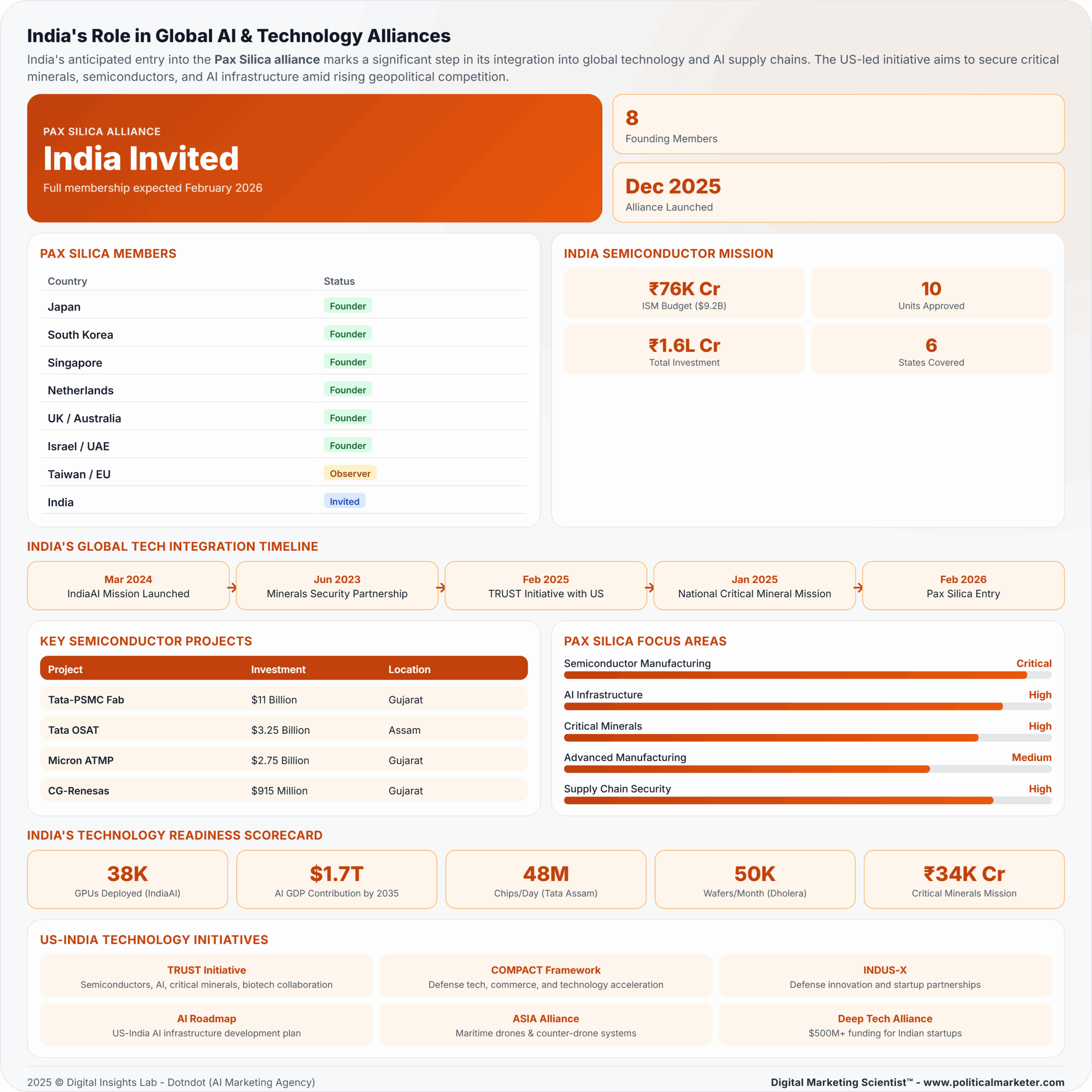
Pax Silica began at its inaugural summit in December 2025 with a focused group of countries that control key segments of the global silicon and AI supply chain. Together, they cover design, manufacturing, equipment, energy, logistics, and advanced research.
Founding and Early Members
The founding group includes:
- United States
- Japan
- South Korea
- Singapore
- Netherlands
- United Kingdom
- Israel
- Australia
- United Arab Emirates
Each member brings a specific strength. You see leadership in chip design, fabrication, lithography equipment, energy supply, logistics hubs, and advanced research. This division of roles reduces single-point dependence across the silicon ecosystem.
Guest and Observer Participants
Several actors joined as guests or observers:
- Taiwan
- European Union
- Canada
- OECD
Their participation signals policy alignment and shared concern over AI and supply chain security, without immediate binding commitments.
Recent Expansions and Momentum
Pax Silica gained momentum in January 2026 through targeted additions that strengthened its resource base and execution capacity.
January 2026 Developments
- Qatar formally joined the alliance on January 12, 2026.
- The United Arab Emirates confirmed and formalized its role on January 15, following earlier participation.
These steps expanded the alliance’s access to energy supply and capital pools. You need both to support large-scale AI manufacturing and data center growth. Chips and compute depend on steady power and long-term financing, not just technical capability.
Why This Matters
AI-scale production faces two hard constraints that often receive less attention:
- Reliable energy at scale
- Sustained capital for infrastructure-heavy projects
By bringing in energy-rich partners, Pax Silica directly addressed these limits. The expansion indicates that the alliance prioritizes practical inputs over symbolic membership.
India’s Upcoming Entry: A Strategic Inflection Point
India’s expected entry into the Pax Silica Alliance marks a shift in how AI and supply chain security are being structured. Its initial absence highlighted gaps in semiconductor capacity and reliance on external suppliers. The invitation extended in early 2026 reflects a change in U.S.–India coordination on technology, trade, and security.
For Pax Silica, India adds manufacturing scale, engineering depth, energy capacity, and a large domestic market for AI deployment. For India, membership offers access to trusted supply chains and deeper integration into the hardware systems that support AI at scale. This mutual fit turns India’s entry into a defining moment for the alliance’s reach and durability.
Initial Exclusion and Vulnerabilities
When Pax Silica launched, India was not part of the founding group. This absence reflected clear concerns that were already evident in India’s supply chain position.
Key issues included:
- Heavy reliance on Chinese imports for critical minerals and components
- Limited domestic semiconductor manufacturing capacity
- A long-standing preference for strategic autonomy in foreign policy
This exclusion triggered debate about India’s exposure to global supply chain shocks and its standing in the AI hardware race. You could see the risk clearly. Dependence without diversification limits resilience.
Diplomatic Shift and Invitation
On January 12, 2026, newly appointed U.S. Ambassador to India Sergio Gor announced in New Delhi that India would receive an invitation to join Pax Silica as a full member in February 2026. He emphasized improving bilateral ties and described the leaders’ relationship as a “real friendship.”
This announcement aligned with renewed trade talks and closer coordination on technology and security between India and the United States. The timing signaled a deliberate policy shift rather than a symbolic gesture.
Why India Matters to Pax Silica
India offers capabilities the alliance needs to scale beyond a narrow group of advanced manufacturers.
India offers:
- Large-scale manufacturing and engineering talent
- Expanding domestic semiconductor programs
- Growing energy capacity and data center infrastructure
- A large internal market that can deploy AI systems at scale
You see the impact on market behavior. After the announcement, public-sector firms in the minerals and energy sectors recorded sharp gains. Investors responded to expectations of higher investment flows and tighter integration into trusted supply chains.
Economic and Market Implications
The Pax Silica Alliance reshapes how markets price risk in AI and hardware supply chains. By coordinating access to chips, energy, and capital among trusted partners, the alliance reduces exposure to supply shocks and policy uncertainty. Investors respond to this shift by favoring firms linked to secure minerals, semiconductors, energy, and data center infrastructure.
You can already see the effect in market behavior. Announcements tied to Pax Silica participation trigger gains in companies in the energy supply, critical materials, and advanced manufacturing sectors. Over time, this framework is likely to redirect investment toward regions and firms embedded in trusted supply networks, while raising the cost of dependence on concentrated or high-risk suppliers.
Short-Term Costs, Long-Term Stability
Reworking global supply chains away from concentrated control raises costs in the near term. You see this most clearly in three areas:
- Building redundant capacity to avoid single-source risk
- Meeting higher labor, safety, and compliance standards
- Funding parallel, capital-heavy infrastructure across regions
These changes increase upfront expenses. Supporters argue the tradeoff makes sense. Over time, you gain stability, predictable access to inputs, and continuity in innovation even during disruptions.
A Coalition of Capabilities
Pax Silica does not operate as a closed bloc. It functions as a coalition that pools complementary strengths across its members. Each participant focuses on a specific segment of the AI and silicon ecosystem.
This structure delivers two outcomes:
- It reduces single-point failures that stall production or deployment
- It speeds collective progress by letting each member do what it does best
For markets, this model shifts value toward coordination and reliability. You trade short-term efficiency for systems that hold under pressure.
Pax Silica as a Conceptual Geopolitical Order
Pax Silica now functions as more than a formal policy effort. You see it used in policy and analytical discussions as a broader framework, similar to how earlier eras used terms like Pax Americana. In this context, Pax Silica refers to an emerging order shaped by technology rather than territory.
In this framing, a Pax Silica–style order implies:
- Semiconductor control is replacing oil security as the primary strategic concern
- Deterrence based on control of computing, fabrication, and manufacturing capacity
- Industrial coordination driven by close public and private cooperation
- Rule-setting power through standards for AI systems, chips, and digital infrastructure
You should also be clear about what Pax Silica is not. No standalone treaty exists under the name “Pax Silica Alliance.” The term serves two roles. It refers to a concrete policy initiative and serves as shorthand for a broader shift toward a technology-centered geopolitical order.
Conclusion
Pax Silica captures a clear shift in how power, security, and economic stability now operate in the AI era. What began as a targeted initiative to secure silicon, energy, and supply chains has evolved into a broader approach to geopolitical order. Control over chips, compute, infrastructure, and standards now matters as much as control over territory or natural resources once did.
The alliance responds to real pressures. Concentrated supply chains, especially in critical minerals and semiconductor production, created exposure that markets and governments can no longer ignore. Pax Silica addresses this by coordinating trusted partners across the whole AI value chain, from materials and manufacturing to energy and capital. Short-term costs rise, but the payoff is resilience, predictability, and continuity in innovation.
India’s expected entry highlights the alliance’s direction. Scale, manufacturing depth, energy capacity, and market size now rank alongside advanced fabrication and research. This shows Pax Silica is not about exclusion but about building a durable system that can sustain AI growth under stress.
Beyond policy, Pax Silica has become a useful analytical lens. It describes a technology-centered order in which rule-setting, deterrence, and economic influence flow from control over silicon and the systems that run on it. Whether the term endures or not, the logic behind it is already shaping decisions. AI security, supply chain control, and coordinated industrial strategy now sit at the core of global power.
Pax Silica Alliance: AI and Supply Chain Security – FAQs
What Does Pax Silica Mean?
Pax Silica is a policy initiative and analytical concept that links global stability to control over silicon, chips, compute, energy, and AI supply chains rather than over territory.
Why Did Pax Silica Emerge Now?
It emerged as governments recognized that concentrated control over minerals, semiconductors, and AI infrastructure creates security and economic risks.
Is Pax Silica a Formal Treaty?
No. There is no standalone treaty named Pax Silica. The term refers to both a specific policy initiative and a broader framework for understanding a technology-centered global order.
What Problem Does Pax Silica Aim to Solve?
It addresses dependence on narrow, high-risk supply chains that support AI hardware, energy, and manufacturing.
How Does Pax Silica Differ From Earlier Geopolitical Orders?
Earlier orders focused on military power and energy resources. Pax Silica centers on chips, compute, standards, and infrastructure.
Which Sectors Matter Most Under Pax Silica?
Semiconductors, critical minerals, energy systems, data centers, advanced manufacturing, and AI infrastructure.
Why Are Semiconductors So Central to the Alliance?
Chips power AI systems, defense technologies, and modern economies. Disruptions directly affect security and growth.
Does Pax Silica Seek Full Decoupling From Global Trade?
No. It focuses on diversification toward trusted partners rather than complete separation from global markets.
Why Is Energy Security Part of Pax Silica?
AI manufacturing and data centers require ample, reliable energy supplies. Without power, compute capacity cannot scale.
How Do Markets Respond to Pax Silica Developments?
Investors tend to favor firms linked to secure supply chains in minerals, energy, chips, and infrastructure.
What Short-Term Economic Costs Does Pax Silica Create?
Higher production costs from redundant capacity, stricter standards, and capital-heavy infrastructure.
Why Do Governments Accept These Higher Costs?
They trade short-term efficiency for long-term stability, resilience, and predictable access to inputs.
What Role Does Coordination Play in Pax Silica?
Members coordinate on investment screening, export controls, subsidies, and responses to economic pressure.
Why Is India’s Entry Considered Significant?
India adds manufacturing scale, engineering talent, energy capacity, and a large market for AI deployment.
What Risks Did India Face Before Joining Pax Silica?
Heavy reliance on external suppliers and limited domestic semiconductor capacity exposed it to supply shocks.
How Does Pax Silica Affect Innovation?
By reducing disruption risk, it supports continuous research, manufacturing, and deployment of AI systems.
Is Pax Silica Limited to Governments Only?
No. Public and private actors both play roles, especially in chips, energy, and infrastructure development.
How Does Standards-Setting Fit Into Pax Silica?
Control over technical standards shapes how AI, chips, and digital systems operate globally.
Does Pax Silica Increase Geopolitical Competition?
Yes. It reflects a shift where technology systems, not territory, define strategic advantage.
Why Does Pax Silica Matter for the Future of AI?
AI depends on physical inputs and coordination. Pax Silica shows that securing these foundations now defines economic and geopolitical power.