
It can be challenging to discern what is true and what is false in a world constantly overwhelmed by news and information. This is especially true when it comes to political communication. With the arrival of the internet and social media, we are more connected than ever. This increased connectivity has led to “fake news” and alternative facts. As a result, psychology—the study of elections and voting behavior—has become more critical than ever. Psychologists use data and analytics to understand how people make decisions during elections.
They consider factors such as election results, polling data, demographic data, and economic data. By doing so, they can provide insights into why people vote the way they do.
Psychologists often use psychological principles to understand voter behavior.
For example, they may use Freudian psychoanalysis to understand the unconscious motivations behind voting behavior.
The study of psychology is essential in today’s political climate.
With the help of psychologists, we can better understand the complex relationship between psychology and politics.
Who is a Political Psephologist?
Political psychologists are experts in the study of elections and voting behavior. They use their skills to analyze poll data and predict election outcomes.
Political psychologists often work for media organizations, think tanks, or political parties.
Universities or other research institutions may also employ them. In addition to their skills in data analysis, political psychologists must also be able to communicate their findings to a non-expert audience.
As a result, they must be able to write clearly and concisely and present their findings in an accessible manner. Political psychologists play an essential role in understanding election outcomes and informing the public about the choices they face at the polls.
Political psychologists are analysts who study election data and trends to predict future elections.
In other words, they use past voting behavior to understand how people will vote in the future.
Political psychology is a relatively new field, and it has only become more critical in recent years as election cycles have become more contentious and unpredictable.
Political psychologists play an essential role in understanding voter behavior and predicting election outcomes.
While they are not always right, their insights can help to shed light on why people vote the way they do and what factors might influence their decisions in the future.
Ways To Digital Psephologist Secrets
Digital psephologists combine political science with data analytics to interpret voter behavior and forecast election outcomes in the digital age. Their work blends traditional survey techniques with cutting-edge tools such as AI, machine learning, and social media analytics to uncover hidden voter trends and shifts in sentiment.
These experts analyze online conversations, search data, and engagement metrics to predict political momentum, measure campaign effectiveness, and detect emerging issues among the electorate. By using heat maps, predictive models, and sentiment graphs, they provide real-time insights that shape campaign strategies.
The true secret of digital psephology lies in the fusion of human intuition and algorithmic precision. It transforms raw digital data into actionable political intelligence, helping parties and strategists anticipate voter behavior, optimize messaging, and secure a decisive advantage in modern elections.
| Aspect | Description |
|---|---|
| Core Objective | To analyze and predict voter behavior using digital tools, data science, and political analytics to support evidence-based campaign strategies. |
| Role of Digital Psephologists | They interpret voter sentiment, predict election outcomes, and identify swing regions using AI-driven data models and online analytics. |
| Data Sources | Social media trends, digital surveys, sentiment analysis, search engine data, online forums, and real-time engagement metrics. |
| Analytical Tools | Machine learning algorithms, predictive modeling, heat maps, NLP sentiment engines, and dashboard-based data visualization. |
| Techniques Used | Microtargeting, demographic clustering, psychographic profiling, and trend forecasting using digital footprints. |
| Applications | Campaign strategy optimization, voter segmentation, issue tracking, and message personalization for specific constituencies. |
| Key Metrics | Engagement rate, voter intent score, swing probability, regional polarity, and emotional sentiment index. |
| Strategic Insights | Helps political parties identify priority regions, refine communication strategies, and more accurately predict electoral outcomes. |
| Secret to Effectiveness | The blend of human intuition with algorithmic precision enables nuanced interpretation beyond raw numbers. |
| Ethical Considerations | Maintaining voter privacy, avoiding data manipulation, and ensuring transparency in analytical interpretations. |
| Impact on Modern Campaigns | Transforms traditional psephology into data-driven intelligence, helping parties stay agile in fast-changing digital environments. |
| Future Outlook | Integration of generative AI, behavioral analytics, and real-time sentiment dashboards will define the next era of digital psephology. |
What is Political Psephology?
Political psephology is the study of election results and voting behaviors. Can use it to predict election outcomes and assess the impact of electoral reforms.
Political reformers use a variety of data sources, including opinion polls, surveys, and census data.
They also use statistical methods to analyze this data. Political psychology is a relatively new field, but it has significantly impacted our understanding of elections and democracy.
Political Psychology is the study of public opinion and electoral behavior. It covers various topics, including voting behavior, campaign effects, and polling methodology.
Political psychologists use various methods to study these topics, including surveys, experiments, and analysis of election data.
Results from political psephology research can improve our understanding of how elections work and inform decision-making by politicians, journalists, and others. Political psephology is thus an essential tool for democracy.
Why Political Psephology?
Political psychology is the study of elections and voting behavior. It can provide valuable insights into the electorate’s mood, the electorate’s views on voters, and how these factors may change over time.
Political psychology can also help predict an election’s outcome and the trends that could impact the result.
Campaign strategists can use this information to develop targeted messaging and advertising, and pollsters can adjust their models. In short, political psychology is a valuable tool for understanding elections and voter behavior.
Political psychology is the study of elections and voting behavior. It is a relatively young discipline, only emerging in the mid-20th century.
However, it has quickly become an essential field of study, shedding light on everything from voting patterns to campaign strategies.
Political psychology is particularly useful in understanding election outcomes.
Analyzing poll data and election results allows psychologists to identify trends and predict future outcomes.
This information is essential for politicians and the general public in a rapidly changing political landscape.
As we enter an era of big data, political psychology will become even more critical.
Using data to understand voting behavior, we can make more informed decisions about running campaigns and governing our countries.
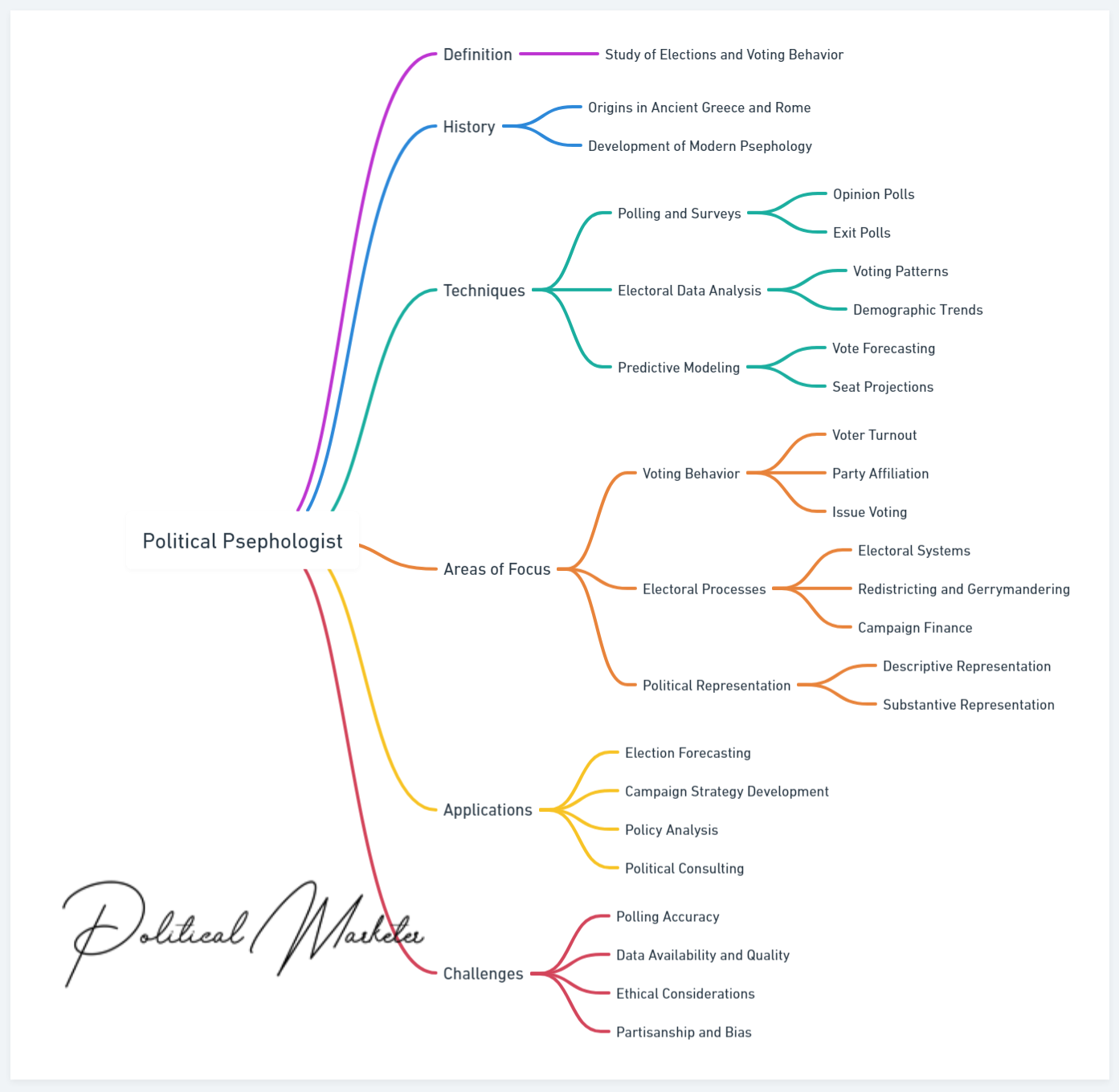
Political Psephologist
What is Statistical Political Science?
Statistical political science is a relatively new field combining rigorous data analysis with traditional political science research methods.
Statistical political scientists use quantitative methods to study topics such as public opinion, elections, campaign finance, and interest groups.
By harnessing the power of data, political statistical scientists can shed new light on some of the most pressing issues facing our democracy.
In recent years, statistical political science has played an essential role in understanding the rise of fake news, the impact of social media on politics, and the dynamics of voter behavior.
As our world becomes increasingly complex, statistical political science insights will become more valuable.
Statistical political science is a field of study that uses quantitative methods to analyze data related to politics and public policy.
Statistical political scientists might use opinion polls to study public opinion on a particular issue or economic data to examine the relationship between tax rates and government spending.
Statistical political science tests hypotheses about how the political system works. It can be used to develop predictive models to help forecast election results or policy outcomes.
Statistical political science constantly evolves as new methods and data sources become available.
However, the primary goal remains to use quantitative methods to improve our understanding of politics and public policy.
Political Science and Political Psychology
Political science is the study of the systems through which people interact to create and maintain societies.
Political scientists ask questions about how power is distributed, what motivates people to participate in politics, and how government policies affect citizens.
Political science also encompasses the study of elections, campaign finance, public opinion, and interest groups.
In recent years, political scientists have increasingly focused on studying Political Psychology.
Political Psychology is the study of how psychological factors influence political behavior.
Political psychologists use methods from cognitive psychology, social psychology, and neuroscience to understand why people vote, form opinions about candidates, and respond to political messages.
By studying the psychological factors that shape political behavior, political psychologists can provide insights to improve our understanding of the political process.
Political science is the study of government structures, processes, and practices.
Political scientists typically specialize in one particular area, such as comparative politics, international relations, or public policy.
Political psychology is a subfield of political science that focuses on the psychological factors that influence political behavior.
Political psychologists may study how personality traits affect voting patterns, how emotions influence decision-making, or how group dynamics shape political attitudes.
Political science and political psychology are both necessary fields of study that can provide insights into the workings of government and the human mind.
The nature of the beast: The Scientific basis for Political Psychology
Political psychologists are scientists who study the voting behavior of the electorate.
They use statistical models and surveys to understand why people vote the way they do and predict how they will vote in the future.
Political psychology is a relatively new science, but it has significantly impacted our understanding of democracy.
Political psephologists have helped us to understand why some countries are more democratic than others, and they have also provided valuable insights into how we can make our democracies more effective.
The need for political psychologists will only grow as our world becomes increasingly complex.
They are the scientists who can help us make sense of the beast that is democracy.
Political psychology is the study of voting behavior and election outcomes.
It is a subfield of Political Science that uses scientific methods to analyze data and predict future trends.
Political psychology has roots in opinion polling, but it has grown to encompass many data sources and analytical techniques.
Political psychologists use statistical models to understand voters’ choices and to forecast election outcomes. They also study the impact of voter turnout on election results and the factors that influence public opinion on political issues.
In recent years, political psychology has played an increasingly important role in election campaigns, as candidates and parties use opinion polls to tailor their messages and strategies.
Political psychology is a complex and ever-changing field, but its insights can be invaluable for understanding and predicting political events.
The History of Political Psephology
Political science is the study of how people interact with their governments and make decisions about public policy.
Psephology is the study of election results and voting behavior.
Psephology comes from the Greek word Paphos, meaning “pebble,” which was used to ca “t votes “in ancient Greece.
Political scientists have used psychology to study elections since the late 19th century.
In the early days of psychology, researchers focused on analyzing election results to better understand voting behavior.
However, modern psychologists use various methods to study elections, including surveys, opinion polls, and exit polls.
By understanding the factors that influence how people vote, psychologists can help to predict election outcomes and shed light on the inner workings of democracy.
Political psychology is the study of elections and voting behavior. It is a relatively new field, having emerged in the late 19th century.
Political psychologists use statistical methods to analyze election data to understand how and why people vote.
The field of political psychology has its roots in political science, but it’s also influenced by sociology,psychology,, and economics.
Political psychologists often work as consultants or pollsters, providing insights into electoral trends and voter behavior.
They also play an essential role in academic research, shedding light on the complex dynamics of elections and voting.
With the help of political psychologists, we can better understand the past, present, and future of democracy.
Political Sepehology and Political Science: A History
Political science studies governments, public policies, and political processes and systems.
Political scientists typically use scientific methods to examine how and why people vote, what influences political leaders’ decisions, and how leaders function.
Political science is a relatively new field of study, having emerged as a distinct discipline in the late 19th century.
However, it can trace its roots back much further. One of the earliest examples of political science was Aristotle’s “Politics,” written” years ago
Many other significant contributions to political science have been made in the centuries since Aristotle.
Political scientists such as John Locke and Jean-Jacques Rousseau helped to shape the field as it is today. Other disciplines, such as history, sociology, and economics, have also influenced political science.
As a result, it is a highly interdisciplinary field of study.
Political science has come a long way since its humble beginnings, but there is still much more to learn about the complex workings of government and politics.
Political science studies governments, public policies, political processes, and political behavior.
Political scientists research and analyze how political systems function and how they impact individuals and society. Political science encompasses various topics, including political theory, international relations, comparative politics, public administration, and even history.
The discipline has its roots in history; Ancient Greek thinkers such as Aristotle and Plato were some of the first to engage in political analysis.
Political science as we know it truly began to take shape in the 19th century, when scholars began using scientific methods to study politics.
Today, political science is a thriving field of academic inquiry with a rich history.
The Political Sepehology of the Digital Age
Political psychology is the study of how digital technology is changing the landscape of political communication.
With the rise of social media, citizens can now connect and share information instantaneously. It has led to a new era of political engagement, where people can dialogue and debate about the issues that matter to them.
Political psychologists are interested in understanding how this new form of communication changes our interactions with political leaders and institutions.
In particular, they are keen to explore how social media can hold politicians accountable and create a more participatory democracy.
As we enter the digital age, Political psychology will become an increasingly important field of study.
Political science has always been interested in the study of power: who has it, how they got it, and how they use it.
With the advent of the digital age, a new power has emerged: the ability to influence public opinion by controlling information.
In the past, those who held this power were limited to those with access to mass media outlets, such as television and newspapers.
However, in the internet age, anyone with a laptop and an internet connection can become a potential gatekeeper of information.
This has ushered in a new era of political propaganda, in which everyone is susceptible to manipulation by those who exploit the power of digital media.
As we enter this new era of politics, it is more crucial than ever to understand the role that information plays in shaping public opinion.
Political science must adapt to this new reality to remain relevant in the 21st century.
The role of Psephologists in today’s Political Climate
Psychology plays an essential role in today’s political climate. In today’s world, “fake news” and alternative facts” abound; psychologists help us to separate fact from fiction.
They use data and analytics to provide insights into why people vote how they do.
By understanding voter behavior, we can decide which candidates to support and which policies to enact.
Psychologists also play an essential role in campaign strategy.
They can help campaigns better target their messaging by understanding which demographics will most likely support a particular candidate or policy position.
Psephologists can help campaigns identify potential swing voters and design targeted campaigns accordingly.
Without the insights of psychologists, campaigns would be flying blind—which would be bad for democracy.
Political Psephologist
A political psephologist is a specialist who studies elections, voting behavior, and political trends using systematic, evidence-based methods rather than surface-level commentary. Unlike general political analysts, who often interpret events after they occur, psephologists focus on measurement, prediction, and the structural understanding of electoral outcomes. The discipline combines political science, statistics, sociology, and increasingly computational and AI-based techniques. The objective is not only to estimate who may win an election, but to explain why outcomes emerge, how voter coalitions shift over time, and which factors consistently influence electoral change.
At the center of political psephology is the analysis of voter behavior. A psephologist examines how demographics such as geography, caste, class, religion, education, income, and occupation interact with political preferences. This includes the study of long-term voting loyalties as well as short-term volatility driven by leadership changes, governance performance, welfare delivery, economic conditions, and social movements. Particular attention is paid to swing voters, first-time voters, turnout patterns, and urban-rural differences, since these elements often determine outcomes in closely contested constituencies. These patterns are measured using historical election data, booth-level results, surveys, and turnout statistics rather than anecdotal observations.
Contemporary political psephology extends well beyond traditional opinion polling. It increasingly relies on statistical modeling and AI-assisted analysis to improve precision and reduce systemic bias. Methods such as regression analysis, probability modeling, clustering, and scenario simulations are used to estimate vote share, seat conversion dynamics, and uncertainty ranges. With the growth of digital political communication, psephologists also analyze social media activity, search behavior, issue salience, and narrative spread to understand how political messages gain traction and when shifts in sentiment are likely to influence actual voting behavior.
An essential responsibility of a political psephologist is to conduct election forecasting with methodological rigor. This involves presenting predictions alongside margins of error, confidence ranges, and clear explanations of assumptions and limitations. Ethical psephology avoids exaggerated certainty and resists pressure to produce simplified or sensational forecasts. By maintaining transparency in sampling methods, weighting approaches, and data sources, psephologists help ensure that electoral analysis remains credible and informative, especially in polarized political environments.
Political psephologists also play a strategic role in campaign planning and post-election assessment. Their analysis helps campaigns identify priority regions, understand constituency-level concerns, and allocate resources more effectively. By mapping voter issues and turnout potential at granular levels, psephologists support targeted outreach and policy communication. After elections, their work helps evaluate the strength of the mandate, regional variations in support, and early indicators of governance challenges.
Political Psephology serves as a structured, evidence-based approach to understanding democratic behavior. In an environment shaped by rapid information flows, emotional messaging, and algorithm-driven narratives, the political psephologist provides analytical clarity grounded in data. As elections become more complex and technology-mediated, this role is increasingly central to both electoral strategy and the broader health of democratic systems.
How Political Psephologists Use Data Science to Predict Election Outcomes Accurately
Political psephologists use data science to move election analysis beyond intuition and headline-driven polling. Their work begins with large-scale electoral datasets, including historical results, turnout patterns, demographic profiles, and constituency-level voting behavior. By identifying long-term alignments and past swing patterns, psephologists establish a structural baseline that explains how different voter groups behave under stable conditions.
This foundation is strengthened through statistical modeling and computational analysis. Techniques such as regression analysis, probability weighting, and scenario simulations allow psephologists to estimate vote share and seat outcomes while accounting for uncertainty. Data science also enables the integration of newer signals such as issue salience, campaign intensity, and digital engagement trends, helping psephologists detect early shifts in voter sentiment. By combining empirical data with transparent methodology, political psephologists produce forecasts that are grounded, explainable, and more resilient to short-term noise.
Understanding the Role of Data in Psephology
As a political psephologist, you rely on data to explain elections, not intuition or media narratives. Data science allows you to study voting behavior systematically across time, geography, and social groups. You work with historical election results, turnout records, demographic distributions, and constituency-level patterns to understand how voters actually behave. This foundation helps you separate stable voting blocs from volatile segments and identify where real electoral movement occurs.
Building a Reliable Electoral Baseline
Every accurate prediction begins with a baseline. You construct this baseline using historical elections to assess vote-share stability, turnout consistency, and seat-conversion trends. This step addresses fundamental questions. Which regions vote consistently? Where do margins stay thin? Which constituencies change hands frequently? Without this groundwork, forecasts rely on surface signals that fail under pressure. Claims about long-term voter loyalty or shifting alignments require evidence from multiple election cycles and should cite official election commission data or verified post-poll surveys.
Using Statistical Models to Measure Probability
Data science gives you tools to quantify uncertainty instead of hiding it. You apply regression models, probability distributions, and scenario testing to estimate outcomes under different conditions. These models help translate vote share into seat outcomes while accounting for variation in turnout and regional bias. When presenting projections, use ranges rather than absolute numbers. Any claim about forecast accuracy or error reduction should reference model validation results, backtesting performance, or peer-reviewed political science research.
Integrating Demographic and Behavioral Signals
You do not treat voters as a single mass. Data science enables segmentation of voters by age, income, education, caste, religion, occupation, and urban or rural location. You analyze how each group responds to leadership, welfare delivery, economic stress, or governance performance. This approach explains why the same campaign message is compelling in one constituency but ineffective in another. Assertions about demographic influence should be supported by census data, large-scale surveys, or booth-level turnout analyses to maintain credibility.
Tracking Narrative and Issue Momentum
Modern psephology includes measuring issue focus and the spread of narratives. You analyze search trends, social media engagement, campaign activity, and local issue visibility to track what voters discuss and when attention shifts. These signals do not replace voting data. They act as early indicators. Claims linking online activity to voting behavior require caution and should cite studies that test for correlation rather than causation, since digital noise often exaggerates political intensity.
Managing Bias and Data Quality
Prediction accuracy depends on how you handle bias. Sampling errors, non-response patterns, and uneven digital access distort raw data. You address these issues by weighting, normalizing, and cross-validating against offline sources. When you publish findings, you explain these adjustments clearly—transparency matters. Statements about reduced bias or improved reliability should reference methodology notes or comparative accuracy assessments from previous elections.
Communicating Forecasts with Discipline
As a political psephologist, your credibility depends on how you communicate results. You avoid certainty when the data do not support it. You explain assumptions, margins of error, and limits upfront. This approach protects public trust and prevents misuse of projections for propaganda. Forecast claims should always reference the data sources, sample size, and modeling approach so readers can evaluate the claims’ strength themselves.
Why Claims’ Science Strengthens Psephology
Data science does not replace political judgment. It sharpens it. By grounding analysis in evidence, you reduce reliance on speculation and emotional narratives. You gain the ability to explain outcomes clearly, challenge weak assumptions, and adjust predictions as conditions change. When used responsibly, data science makes psephology more accountable, more transparent, and more useful to democratic understanding.
Ways To Political Psephologist
Becoming a political psephologist requires developing skills in analyzing election data and voter behavior, and in evidence-based interpretation. You begin by learning how elections work at the constituency and booth levels, using verified results and turnout records rather than opinion alone. This foundation helps you understand long-term voting patterns and identify where margins shift.
You then develop analytical capabilities through statistics, data science, and AI-supported tools to model voter movement and variation in turnout. Alongside technical skills, you train yourself to test political narratives against data and explain outcomes with clarity and discipline. The path to political psephology combines method, evidence, and restraint rather than prediction or commentary.
| Area of Focus | What You Need to Do |
|---|---|
| Understanding Elections | Study how elections work at the constituency and booth levels using official results and turnout records. |
| Learning Voter Behavior | Analyze how voters shift preferences, change turnout, and respond to leadership, issues, and local factors. |
| Data Skills | Learn statistics, data analysis, and basic data science to work with large election datasets accurately. |
| Turnout Analysis | Track participation patterns across elections to understand how turnout affects marginal outcomes. |
| Historical Comparison | Compare multiple election cycles to identify stable voting blocs and swing behavior. |
| Use of AI Tools | Apply AI carefully to process scale, test scenarios, and detect patterns without replacing judgment. |
| Narrative Testing | Evaluate political narratives against real voting data instead of accepting media claims. |
| Geographic Analysis | Work with constituency-, ward-, and booth-level data to capture local dynamics that averages miss. |
| Method Transparency | Clearly explain data sources, assumptions, and limits in every analysis you produce. |
| Ethical Discipline | Focus on explanation and evidence, not hype, prediction theatrics, or partisan amplification. |
What Role Does AI Play in Modern Election Forecasting and Psephology
AI plays a supporting but decisive role in how you, as a political psephologist, analyze and forecast elections today. It helps you process large volumes of electoral data, detect patterns across time and regions, and quickly test multiple scenarios. Rather than replacing traditional psychological methods, AI enhances them by improving the scale, speed, and consistency of analysis.
You use AI to model voter behavior, estimate shifts in turnout, and identify early signals of change from demographic data, issue attention, and campaign activity. These systems help reduce manual bias and highlight relationships that are difficult to discern through conventional analysis alone. When applied with transparency and explicit assumptions, AI allows political psephology to produce forecasts that are more structured, explainable, and grounded in evidence rather than speculation.
AI as an Analytical Tool, Not a Replacement
As a political psephologist, you use AI to support analysis, not to replace core electoral reasoning. AI helps you handle scale. Elections generate large volumes of data across constituencies, voter groups, and time periods. AI systems process this data faster and more consistently than manual methods. However, interpretation remains your responsibility. AI highlights patterns. You decide which patterns matter and which reflect noise.
Processing Large Electoral Datasets
AI enables you to work with complex datasets that include historical election results, turnout records, demographic variables, survey responses, and booth-level data. Machine learning models help you identify correlations across regions and voter segments that traditional analysis may miss. Claims about pattern discovery or improved accuracy should be supported by documented model performance and by validation against past election outcomes using official election commission data.
Modeling Voter Behavior at Scale
You use AI to analyze how different voter groups respond to leadership, governance outcomes, economic stress, and policy delivery. Clustering and classification models group voters by behavior rather than assumptions. This helps explain why similar demographic groups vote differently across regions. Any claim that AI improves voter segmentation should cite comparative studies between traditional demographic models and data-driven behavioral groupings.
Turnout and Swing Detection
AI improves your ability to track turnout sensitivity and swing potential. By comparing past turnout trends with current indicators, AI models help you estimate where participation may rise or fall. This matters because turnout often decides close contests. Assertions about the accuracy of turnout predictions should cite historical backtesting and error margins from prior elections.
Early Signal Identification
AI assists in monitoring early indicators such as issue focus, campaign intensity, and digital engagement patterns. These signals help you detect shifts before they appear in polling data. You treat them as indicators rather than as proof. Claims linking digital signals to voting outcomes require evidence from longitudinal studies demonstrating that observed changes translate into actual votes.
Bias Control and Error Reduction
You use AI to identify and correct bias in datasets. Sampling imbalance, regional overrepresentation, and response gaps distort forecasts. AI-based weighting and anomaly detection help you address these issues. Statements about reduced bias should cite methodology notes, validation results, or independent audits of forecasting accuracy.
Scenario Testing and Risk Assessment
AI supports scenario modeling. You test outcomes under different assumptions, such as variations in turnout, changes in alliances, or regional swings. This helps you explain risk rather than predict certainty. When presenting scenarios, clearly define the assumptions so leaders understand their implications. Claims about forecast robustness should specify the number of scenarios tested and the extent of variation in results.
Transparency and Accountability
AI increases responsibility, not secrecy. As a psephologist, you explain how models work, what data they use, and where they fall short. Black box predictions weaken trust. You maintain credibility by documenting sources, assumptions, and margins of error. Any public forecast should cite data sources, model type, and validation method.
How Voter Behavior Modeling Helps Psephologists Decode Swing Elections
Voter behavior modeling helps you, as a political psephologist, explain why closely contested elections shift in unexpected ways. By analyzing past voting patterns, changes in turnout, and demographic responses, you can identify which voter groups shift between parties and under what conditions. This approach shows you where margins remain fragile and which constituencies respond quickly to leadership changes, policy delivery, or local issues.
Using data-driven models, you can track swing voters, turnout sensitivity, and cross-voting behavior with greater precision. These insights allow you to distinguish structural loyalty from short-term movement. Instead of relying on broad sentiment claims, voter behavior modeling gives you clear evidence of how and where elections swing, and why small changes in participation or preference produce decisive outcomes.
Why Swing Elections Need Behavioral Analysis
As a political psephologist, you know that swing elections do not change because entire electorates shift at once. They change because small, specific voter groups alter their behavior. Voter behavior modeling helps you isolate these shifts with precision. Instead of asking who is popular, you focus on who moved, where they moved, and why that movement mattered. This approach replaces broad sentiment claims with measurable behavioral evidence.
Separating Stable Voters from Swing Voters
Not all voters decide elections. Many vote the same way across cycles. Voter behavior modeling helps you separate stable voters from swing voters using past election results, turnout records, and preference shifts. You identify constituencies in which margins remain narrow and voter loyalty remains weak. Claims about the impact of swing voters should rely on multi-election comparisons using official election commission data and constituency-level results.
Tracking Vote Share Movement Across Elections
You analyze how vote share changes across consecutive elections at the booth, ward, and constituency levels. Even small shifts matter. A two- or three-percent movement can flip outcomes in tightly contested seats. Modeling allows you to determine whether these shifts arise from party switching, variation in turnout, or first-time voter participation. Any statement about vote-share trends should cite verified election results rather than rely solely on survey data.
Understanding Turnout Sensitivity
Turnout often decides swing elections. Voter behavior models help you measure which voter groups vote consistently and which groups drop out or mobilize under specific conditions. You examine patterns such as urban disengagement, rural overparticipation, or youth turnout volatility. Claims about turnout-driven outcomes require evidence from historical turnout data matched against final results.
Demographic and Local Issue Influence
You do not treat demographics as fixed predictors. Voter behavior modeling shows that the same demographic group responds differently to local leadership, welfare delivery, employment conditions, or governance credibility. This explains why identical caste or income groups vote differently across regions. Assertions about demographic influence should cite census data, survey research, or booth-level turnout correlations.
Detecting Short-Term Versus Long-Term Change
Swing elections often combine short-term anger with long-term dissatisfaction. Modeling helps you distinguish between temporary protest voting and durable realignment. You test whether voter movement repeats across elections or disappears once conditions change. Claims about realignment should rely on repeated patterns across at least two election cycles.
Reducing Guesswork in Election Narratives
Campaign narratives often exaggerate momentum. Voter behavior modeling acts as a corrective. You test claims about wave elections, silent voters, or late swings against actual behavioral data. This protects analysis from media-driven exaggeration. Any claim that challenges popular narratives should cite counter-evidence based on verified data.
Using Models to Explain, Not Predict Alone
Prediction matters, but explanation matters more. Voter behavior modeling helps you explain why an election swung, not just that it did. You show how turnout, preference shifts, and demographic response combined to change outcomes. As one election researcher observed, “Elections rarely surprise data. They surprise assumptions.” That principle guides serious psephological work.
Voter behavior modeling gives you clarity in elections decided by narrow margins. It replaces speculation with structure and allows you to explain swing outcomes in a way that holds up under scrutiny.
Why Traditional Opinion Polls Fail and How Psephology Has Evolved
Traditional opinion polls often fail because they rely on limited samples, static questions, and assumptions about voter honesty and turnout. As a political psephologist, you see these limits clearly when polls miss late shifts, underestimate turnout differences, or fail to capture local dynamics that decide close contests. Polls measure stated preferences at a single point in time, not actual voting behavior under election conditions.
Phenology has evolved by moving beyond poll snapshots toward behavioral and data-driven analysis. You now combine historical results, turnout patterns, demographic movement, and issue response to explain elections more accurately. This shift allows you to test claims, correct bias, and focus on evidence rather than headline predictions.
Limits of Traditional Opinion Polls
As a political psephologist, you see clear limits in standard opinion polls. Polls rely on small samples that rarely capture constituency-level variation. They depend on self-reported preferences, which often differ from actual voting behavior. Respondents conceal their intent, change their decisions late, or disengage on polling day. Polls also struggle with turnout estimation, particularly among young voters, migrant populations, and in regions with low participation. Any claim about poll accuracy should cite past election outcomes and compare them with final pre-poll or exit-poll estimates from recognized agencies.
Sampling and Response Bias
Polling errors often begin with sampling. Urban voters respond more than rural voters. Educated voters respond more than working-class voters. Digital surveys exclude citizens without reliable internet access. These gaps skew results even before analysis begins. When you observe consistent overestimation of one party across regions, sampling bias usually accounts for the gap. Statements about bias correction require evidence from sample-composition reports and post-election audits.
Failure to Capture Local Dynamics
Polls ask national- or state-level questions. Elections turn on local issues. Leadership reputation, candidate credibility, welfare delivery, caste arithmetic, and booth-level mobilization determine outcomes in swing seats. Polls flatten these differences into averages that hide decisive variation. Claims about local influence should cite constituency-level results in which polling trends diverged from outcomes.
Turnout Blind Spots
Most polls assume uniform turnout. Honest elections never follow that pattern. Small changes in participation flip results in close contests. Polls rarely model turnout with precision because respondents overstate their likelihood of voting. When turnout varies by age, gender, or region, poll projections break down. Any statement about turnout effects should rely on historical turnout data matched against final margins.
Static Questions in Dynamic Elections
Polls capture opinion at a fixed moment. Elections evolve. Campaign intensity, alliances, last-minute events, and administrative factors can rapidly change voter behavior. Static surveys fail to track momentum or late shifts. Claims about late swings should reference timelines in which polling ended days before voting and outcomes diverged sharply.
How Psephology Has Shifted the Approach
Modern psephology moves away from snapshot polling toward behavioral analysis. You combine historical results, turnout patterns, demographic responses, and constituency-specific data to explain outcomes. This method treats elections as systems shaped by structure and change, not as opinion contests alone. Claims about improved accuracy should reference multi-election backtesting using official election commission data.
From Preference to Behavior
Psephology focuses on what voters do, not only what they say. You study changes in vote share, shifts in turnout, and party switching across elections. This reveals which voter groups drive change and which remain stable. Statements about voter movement should rely on booth- or ward-level comparisons across cycles.
Using Data to Test Narratives
Campaigns and media promote simple stories about waves, anger, or momentum. Psephology tests these stories against evidence. You verify whether a claimed surge reflects real turnout growth or selective visibility. As one election analyst said, “Narratives explain headlines. Data explains outcomes.” That distinction guides serious analysi”.
ow Political Narrative Analysis Influences Electoral Predictions Today
Political narrative analysis helps you, as a political psephologist, understand how stories, issues, and framing shape voter behavior beyond raw numbers. By tracking which themes gain attention, who drives them, and where they spread, you assess how narratives influence turnout and voter choice, especially in closely contested elections.
This analysis does not replace data-driven modeling. It adds context. When combined with historical results and voter behavior patterns, narrative signals help you explain why sentiment shifts occur and when they translate into actual votes.
Why Narratives Matter in Electoral Analysis
As a political psephologist, you know that voters do not respond only to policies or numbers. They respond to stories that explain blame, promise relief, or signal identity. Narrative analysis helps you understand how these stories shape voter perception and behavior. Elections often shift when a narrative reframes governance success, economic stress, leadership credibility, or social tension. Ignoring narratives leads to forecasts that miss late movement and turnout swings.
What Political Narrative Analysis Examines
Narrative analysis focuses on how political messages form, spread, and sustain attention. You analyze the language used by parties, leaders, the media, and local influencers to identify which themes dominate voter discourse. This includes issue framing, emotional triggers, and repetition across platforms. Claims about narrative dominance should rely on measured indicators such as message frequency, geographic spread, and persistence over time using verifiable media or communication datasets.
Narratives and Voter Behavior
Narratives influence how voters interpret facts. A welfare scheme can signal support or dependency depending on framing. An economic slowdown can signal mismanagement or global pressure, depending on who controls the narrative. You analyze how these frames affect turnout and vote switching, particularly among undecided and low-engagement voters. Statements linking narrative shifts to voting outcomes require evidence from election cycles in which messaging intensity changed alongside measurable shifts in vote share.
Identifying Early Signals of Change
Narrative analysis helps you detect early shifts before they appear in polling data. When voter discussion moves from performance to trust, or from identity to cost of living, behavior often follows. You treat these shifts as indicators, not conclusions. Claims about early signal accuracy should cite past elections in which narrative changes preceded changes in turnout or preferences.
Separating Noise from Influence
Not every loud message changes votes. Narrative analysis helps you separate visibility from influence. You test whether a message reaches undecided voters or circulates only within loyal groups. This prevents overestimating social media intensity or media coverage. Assertions about influence should rely on cross-platform comparisons and constituency-level responses rather than on volume alone.
Combining Narratives with Data Models
Narrative analysis is most effective when paired with voter behavior and turnout models. You use narratives to explain why data shifts occur, not to replace evidence. When turnout rises in one region and falls in another, narrative context accounts for the variation. Claims that narrative analysis improves prediction should cite cases in which narrative indicators have improved model accuracy or reduced forecast error.
Limits of Narrative Analysis
Narratives do not override structure. Strong party loyalty, demographic alignment, and past voting patterns still constrain outcomes. As a psephologist, you treat narratives as accelerators rather than foundations. Overreliance on messaging without data leads to false wave claims. A senior election analyst once noted, “Narratives explain movement. Structure explains limits.” That distinction keeps analysis “grounded.
Why Narrative Analysis Shapes Modern Forecasting
Elections today move fast. Voters absorb information continuously and react unevenly. Narrative analysis helps you understand timing, momentum, and emotional responses that raw data cannot explain on its own. When used with discipline and evidence, it sharpens electoral prediction and strengthens explanation.
Political narrative analysis alone does not predict votes. It explains why voters move when they do, and why numbers change as they do. That makes it an essential tool in modern psephology.
What Makes a Political Psephologist Different From a Pollster or Analyst
A political psephologist differs from a pollster or general analyst in focus and method. As a psephologist, you study elections as systems shaped by behavior, turnout, and long-term patterns rather than isolated opinions or daily events. Pollsters measure stated preference at a point in time. Analysts interpret political developments. You explain how votes move, why margins change, and which factors actually decide outcomes.
By combining historical results, voter behavior modeling, turnout analysis, and narrative context, psephology tests claims against evidence. This approach reduces reliance on headlines and short-term sentiment. It allows you to explain elections with clarity and accountability, rather than merely comment on them.
Different Core Questions
As a political psephologist, you ask different questions than a pollster or a general analyst. Pollsters ask voters what they prefer at a specific moment. Analysts explain political events and leadership moves. You examine how votes shift across elections, why turnout varies, and which voter groups determine outcomes. Your work centers on behavior, not opinion snapshots or commentary.
Focus on Behavior, Not Statements
Polls rely on what respondents say. You rely on what voters do. You study vote-share movements, variation in turnout, party switching, and constituency-level results across multiple elections. This approach exposes gaps between stated preferences and actual voting behavior. Claims about behavioral consistency or change should rely on verified election results from official election authorities.
Use of Historical Evidence
A psephologist works with time series data. You compare elections across cycles to identify stable patterns and points of disruption. Pollsters often treat each election as a fresh event. Analysts focus on the current cycle. You treat elections as part of a more extended sequence. Statements about long-term voter loyalty or erosion require evidence from at least two election cycles.
Turnout as a Central Variable
Turnout rarely figures prominently in polling analysis. For you, it often decides the result. You measure who votes consistently, who drops out, and who mobilizes under pressure. Small turnout shifts can flip close seats. Any claim about the impact of turnout should reference historical turnout data matched with final margins.
Granular Geographic Analysis
Polls aggregate results. You disaggregate them. You work at the booth, ward, and constituency levels to understand local dynamics. Candidate credibility, local delivery, and micro-level mobilization often explain results that state-level averages miss. Assertions about local influence should cite constituency-specific outcomes in which aggregate trends have failed to hold.
Narrative Testing, Not Narrative Repetition
Analysts often repeat dominant political narratives. You test them. Claims about waves, silent voters, or late surges mean little unless data support them. You compare narrative intensity with actual behavioral change. As one election researcher noted, “Narratives explain attention. V” tes explain outcomes.” That distinction defines your “ole.
Forecasting With Accountability
When you forecast, you show limits. You explain assumptions, error ranges, and uncertainty. Pollsters publish point estimates. Analysts offer directional views. You provide structured, evidence-based explanations. Claims about forecast accuracy should cite past projections tested against final results.
Role in Campaigns and Public Understanding
You do not sell optimism or panic. You explain risk. Campaigns use your work to identify weak seats, turnout gaps, and voter drift. The public uses it to understand why elections yield particular outcomes. This responsibility requires discipline and transparency.
A political psephologist differs in that their work does not stop at prediction or commentary. You explain elections in ways that hold up after votes are counted.
How Social Media Signals Are Changing Electoral Prediction, Models
Social media signals give you, as a political psephologist, additional context about voter attention and issue focus, but they do not replace electoral data. By tracking discussion volume, topic shifts, and engagement patterns, you can detect early signs of changing sentiment, particularly among undecided or low-participation voters.
When combined with historical results and voter behavior models, these signals help you explain timing and momentum in close elections. Used carefully, social media data sharpens interpretation without overstating influence or mistaking noise for votes.
Why Social Media Data Matters to Psephology
As a political psephologist, you treat social media as a signal source, not a vote counter. Platforms reveal what voters discuss, which issues gain attention, and how fast narratives spread. This information helps you understand the timing and direction of voter interest, especially in competitive elections. Claims about the relevance of social media should rely on studies that compare online discussion patterns with verified election outcomes across multiple cycles.
What Social Media Signals Actually Measure
Social media does not directly measure voter intent. It measures attention, emotion, and repetition. You track variables such as topic frequency, engagement patterns, geographic spread, and persistence over time. These signals show where political focus intensifies or fades. Any claim that online volume reflects voter strength requires caution and supporting evidence from studies correlating turnout or vote share with online volume.
Early Detection of Issue Shifts
Social media helps you detect shifts in issues before they appear in surveys. When the conversation moves from governance to prices, employment, or trust, voter behavior often follows. You use this data to flag potential change, not to confirm outcomes. Statements about early detection should cite elections in which online issue mobilization preceded measurable changes in voting or turnout.
Separating Noise From Influence
Not every trend matters. Highly active users and coordinated campaigns inflate volume without a broad impact. You control for this by comparing engagement diversity, geographic spread, and crossover into offline discussion. Claims about influence should be supported by evidence demonstrating that online signals reached undecided or low-engagement voters.
Integrating Signals Into Prediction Models
You do not replace core models with social media data. You layer these signals onto voter behavior and turnout models to improve explanation and timing. Social media helps explain why data shifts occur, not whether they will appear. Claims about model improvement should cite backtesting results showing that social inputs reduced forecasting error.
Turnout and Mobilization Indicators
Social media can signal mobilization intensity. High localized activity often indicates volunteer effort, event participation, or issue-driven turnout. You treat this as a turnout indicator rather than as proof of preference. Statements linking mobilization signals to turnout outcomes require verification using polling day participation data.
Bias and Representation Limits
Social media users do not represent the full electorate. Urban, young, and politically engaged citizens dominate these platforms. As a psephologist, you adjust for this bias and avoid direct vote inference. Claims about representativeness should reference platform usage data and the extent of emographic coverage gaps.
Maintaining Analytical Discipline
Social media adds context, not certainty. Overreliance leads to false momentum claims and exaggerated swings. You maintain discipline by testing every signal against historical patterns and real voting behavior. As one election analyst said, “Attention moves faster than vo” es.” That principle keeps models grounded.
Social media signals reshape how you interpret elections, not how you count them. Used carefully, they sharpen timing, explanation, and risk assessment in modern psephology.
Can AI-Driven Psephology Predict Elections Better Than Exit Polls
AI-driven psephology improves election prediction by analyzing voter behavior, turnout patterns, and historical results before polling day. As a political psephologist, you use AI to model how different voter groups respond over time, which allows you to explain outcomes rather than react to them after voting ends. This approach reduces reliance on last-minute surveys that often miss variation in turnout and local dynamics.
Exit polls capture voter responses after voting, but they remain vulnerable to sampling gaps and reporting bias. AI-driven psephology does not replace exit polls, but it often provides a more stable and explainable forecast when grounded in verified data and transparent methods.
What Each Method Tries to Measure
As a political psephologist, you work with two very different tools. Exit polls collect voter responses after voting ends. They capture stated choice at polling stations. AI-driven psephology models behavior before and during elections using historical results, turnout patterns, demographic response, and local dynamics. One measures reported choice at the end. The other explains how outcomes form.
Strengths and Limits of Exit Polls
Exit polls offer quick snapshots, but they carry structural limits.
- They rely on voluntary disclosure, which introduces the risk of misreporting and social pressure.
- They struggle with turnout imbalance, especially among women, youth, and migrant voters.
- They often miss local variations because samples remain thin at the constituency level.
Claims about exit poll accuracy should cite past elections in which projections diverged from final results based on official election commission data.
How AI-Driven Psephology Works
AI-driven psephology does not guess preferences. You use it to analyze patterns.
- Vote share movement across multiple election cycles
- Turnout sensitivity by region and voter group
- Party switching and alliance effects
- Local issue response and candidate influence
These models test scenarios before voting ends. Any claim of improved accuracy requires back testing against past elections and transparent error reporting.
Why AI Models Handle Turnout Better
Turnout decides close elections. Exit polls often assume uniform participation. You do not. AI models enable estimation of variation in turnout using historical behavior, mobilization signals, and local conditions. When turnout shifts by small margins, these models explain why seats flip. Assertions about turnout prediction should cite historical turnout matched with final margins.
Timing Advantage Over Exit Polls
Exit polls react after voting. AI-driven psephology works earlier. You can assess risk, momentum, and weak seats days or weeks before polling day. This helps campaigns adjust their strategies and helps observers infer likely outcomes without waiting for polling stations to close.
Bias Control and Transparency
Exit polls hide bias behind headline numbers. AI models force disclosure. You explain data sources, assumptions, and uncertainty ranges. This transparency builds trust. Claims about bias reduction should reference documented weighting methods and validation results.
Where AI Falls Short
AI does not read minds. It depends on data quality. Sudden shocks on polling day, administrative failures, or last-minute events can still catch models off guard. As a psephologist, you treat AI as an analytical aid, not an oracle.
Which Performs Better and When
AI-driven psephology often performs better in explaining outcomes and managing uncertainty, especially in swing elections. Exit polls remain useful for confirmation and media reporting. They do not replace behavioral analysis.
As one election researcher observed, “Exit polls describe the finish line. Psephology explains the race.” That distinction defines thei” oles.
AI-driven psephology does not eliminate uncertainty. It reduces guesswork. When used with discipline and evidence, it offers a stronger framework for understanding elections than exit polls alone.
How Political Campaigns Use Psephological Insights to Win Marginal Seats
Political campaigns use psephological insights to identify where narrow margins decide elections and why those margins shift. As a political psephologist, you help campaigns understand turnout gaps, voter switching patterns, and local factors that separate winning from losing in closely contested seats.
By analyzing past results, demographic responses, and constituency-level behavior, psephology guides targeted outreach and resource allocation. This approach allows campaigns to focus their efforts where they can influence outcomes, rather than where support is already fixed.
Why Marginal Seats Decide Elections
As a political psephologist, you focus on marginal seats because they determine outcomes. These constituencies show narrow vote margins, unstable turnout, and frequent party switching. Campaigns that treat all seats equally waste resources. You help them focus on where small changes determine outcomes. Claims about marginal seat impact should rely on constituency-level margins from official election commission data across at least two election cycles.
Identifying True Marginal Constituencies
Not every close result signals a marginal seat. You distinguish between temporary closeness and structural vulnerability. Using historical vote share, turnout patterns, and candidate effects, you classify seats by risk. This prevents campaigns from chasing noise. Any classification method should account for past election outcomes and the consistency of margins over time.
Understanding Voter Movement Inside Margins
Winning a marginal seat rarely requires converting large voter blocks. It requires understanding who moves and why. You analyze:
- Party switching between elections
- Turnout drop or rise among specific groups
- First-time voter participation
- Local dissatisfaction or approval
Statements about voter movement should cite booth- or ward-level comparisons based on verified results.
Turnout as a Winning Lever
Turnout often decides marginal contests. You show campaigns in which voter groups stay home and those that respond to mobilization. This shifts focus from persuasion alone to participation. When campaigns raise turnout among favorable but disengaged voters, margins change. Claims about turnout-driven wins should reference historical turnout data matched with final margins.
Local Issue Mapping and Candidate Impact
National messaging rarely decides marginal seats. You map local issues, including gaps in welfare delivery, employment access, infrastructure delays, and candidate credibility. This explains why identical messaging is effective in one seat but ineffective in another. Assertions about local influence should rely on constituency-specific voting outcomes, rather than on broader trends that do not apply.
Targeted Resource Allocation
Psephological insight guides where campaigns spend time, money, and personnel. You advise campaigns to:
- Increase booth-level presence where margins stay thin
- Focus outreach on undecided and low turnout groups
- Avoid overinvestment in safe seats
Claims about resource efficiency should cite campaign data that link changes in turnout or vote share to changes in resource allocation.
Testing Campaign Narratives Against Data
Campaigns often believe strong narratives guarantee success. You test those beliefs. If a message does not shift turnout or preference in marginal seats, it fails regardless of visibility. As one election analyst stated, “Winning narratives change behavior, not volume.” This principle keeps” strategy grounded.
Monitoring Late Phase Risk
Marginal seats remain sensitive until polling day. You track late signals such as turnout momentum, alliance behavior, and local sentiment shifts. This helps campaigns adjust ground operations without panic. Any claim about late phase correction should cite documented changes in turnout or booth performance.
Ethical Boundaries and Accountability
Psephological insight informs strategy. It does not justify manipulation or misinformation. You maintain credibility by grounding advice in evidence and explaining limits. Campaigns benefit from clarity rather than exaggeration.
Political campaigns win marginal seats when they stop guessing and start measuring. Psephology gives you the tools to explain where effort matters, why margins move, and how small shifts decide elections.
What Data Sources Do Political Psephologists Trust for Election Forecasts
Political psephologists rely on verified and repeatable data sources rather than headline-driven indicators. You trust official election results, turnout records, and constituency-level vote shares as the foundation for any forecast. These sources show what voters actually did, not what they claimed they would do.
You supplement this core data with demographic records, long-term survey datasets, and validated behavioral indicators, such as turnout trends and issue responses. When used together and tested across multiple elections, these sources enable the construction of forecasts that remain grounded, transparent, and explainable.
Why Data Quality Matters More Than Data Volume
As a political psephologist, you care less about how much data exists and more about whether it reflects real voting behavior. Reliable forecasts begin with sources that remain consistent across elections, are verifiable, and support comparisons over time. Data that cannot be audited or replicated weakens analysis, regardless of how current or popular it appears.
Official Election Results as the Core Reference
You treat official election results as the primary source for all serious analysis. These records present vote shares, margins, turnout, and seat outcomes at the constituency and booth levels. They reveal how voters actually behaved rather than how they reported their preferences. Certified results published by election authorities should support any claim about voter movement, party strength, or regional change.
Turnout Records and Participation Trends
Turnout data is as essential as vote share. You analyze who voted, where participation rose or fell, and how turnout shifted across elections. Small turnout changes often explain significant shifts in outcomes in close contests. Claims about turnout-driven outcomes require matching participation data with final margins across multiple cycles.
Constituency and Booth Level Data
Aggregate numbers hide decisive detail. You rely on granular data that enables you to examine voting behavior at the ward, booth, or polling-place level. This data helps identify micro-level candidate effects and local dissatisfaction that state or national averages may obscure; analysis of marginal seats or swing regions depends on this level of detail.
Demographic and Census Data
You use census data to understand population structure, not to predict votes directly. Age distribution, migration patterns, urban growth, education levels, and employment categories provide context for shifts in turnout and preferences. Claims linking demographics to voting behavior should reference both census data and election results to avoid reliance on assumptions.
Longitudinal Survey Datasets
You treat surveys cautiously and selectively. One-off opinion polls add little value. Long-running surveys that track the same questions across elections offer greater insight. These datasets enable analysis of attitude stability, trust levels, and issue response over time. Any claim based on survey data should disclose sample size, methodology, and consistency across cycles.
Behavioral Indicators With Validation
You may use behavioral indicators such as past turnout consistency, party-switching rates, and alliance-transfer patterns. These indicators matter only when validated against actual results. Claims about behavioral trends should be supported by backtesting against at least two prior elections.
Limited Use of Digital and Media Signals
You treat social media and media coverage as context rather than evidence. These signals help explain attention and timing, not vote totals. You use them to support interpretation after verifying that similar patterns appeared in earlier elections with measurable outcomes. Any claim that digital signals predict voting behavior should cite studies demonstrating correlations with the changes in turnout or vote share
Why Some Popular Data Gets Rejected
You avoid data that lacks transparency, overrepresents narrow groups, or cannot be audited. This includes unverified online polls, anonymous dashboards, and engagement metrics presented without demographic correction. Visibility does not equal voter support.
How You Combine Trusted Sources
No single dataset predicts elections. You combine verified results, turnout records, demographic context, and validated behavioral trends. This layered approach allows you to explain outcomes clearly and test assumptions before making claims.
As one election researcher put it, “Votes leave a rec” rd. Opinions leave noise.” That principle guides which data a political psephologist trusts and which data gets filtered out.
Conclusion
In today’s political environment, psychology is more critical than ever before.
Psephologists help us understand voter behavior so we can make informed choices about which candidates to support and which policies to enact.
They play an essential role in campaign strategy by helping campaigns identify potential swing voters and target their messaging accordingly.
So next time you hear someone talking about the importance of data in political campaigns, remember that it’s not just abouit’smbers—it’s about understit’sng people, too.
Social media is one of the essential tools for a psychologist in the digital age.
With billions of people using social media platforms like Facebook and Twitter, it’s more important than ever to understand how these platforms can influence public opinion.
That’s why we offer political consulting services that focus on leveraging the power of social media to win elections. Contact us today to learn how to win your next election.
Call: +91 9848321284
Email: [email protected]
Digital Psephologist Secrets: FAQs
What is a political psephologist?
A political psephologist is an expert who studies and analyzes elections, voting patterns, and electoral data to interpret and predict political trends and outcomes.
What does the term ‘psephology’ mean?
Psephology is the scientific analysis of elections and voting behavior, derived from the Greek word psephos, meaning “pebble,” which ancient Greeks used for voting.
What are the main responsibilities of a psephologist?
They analyze electoral data, conduct opinion polls, interpret voting trends, forecast election outcomes, and offer strategic insights for campaigns or media.
What skills are required to be a psephologist?
Data analysis, political science understanding, statistical modeling, critical thinking, public opinion research, and communication are essential.
How do psephologists collect data?
They gather data through surveys, exit polls, historical trends, demographic studies, GIS mapping, and digital sentiment analysis tools.
How is a psephologist different from a political analyst?
Psephologists focus on elections and voting trends, while political analysts interpret broader policy issues, legislative activity, and political ideologies.
Can psephologists accurately predict election results?
They offer projections based on data modeling and statistical trends, though accuracy depends on sample quality, turnout, and external factors.
Where do psephologists work?
They work with media houses, polling agencies, universities, political consultancies, research think tanks, and sometimes independently.
Are psephologists important in election campaigns?
Yes. They help campaigns shape voter targeting, messaging, constituency prioritization, and real-time response strategies.
Do psephologists use technology in their work?
Yes. Tools include SPSS, R, Tableau, AI-based forecasting systems, and election-specific CRM and visualization platforms.
What is the difference between exit polls and opinion polls?
Exit polls are conducted after voting, while opinion polls survey preferences before the election, reflecting pre-poll sentiment.
Who are some famous psephologists in India?
Renowned names include Prannoy Roy, Yogendra Yadav, Dorab Sopariwala, and Sanjay Kumar, known for their election expertise and analysis.
Can psephology be studied academically?
Yes. It is part of political science, statistics, and public policy programs, and can also be pursued through specialized training or research.
What role do psephologists play in media coverage of elections?
They interpret data, decode voter behavior, present live trends, and offer commentary during results and pre-election shows.
Do psephologists influence political parties?
Yes. Their findings often guide campaign strategies, messaging tone, regional focus, and candidate positioning.
What are the limitations of psephology?
Challenges include limited data access, sampling errors, voter unpredictability, regional variations, and shifting sentiments near election day.
How do psephologists ensure accuracy in their predictions?
By using scientifically representative samples, validating cross-segment data, applying weights, and using rigorous statistical models.
Is psephology relevant in local or panchayat elections?
Yes, although data availability can be limited. It offers valuable insights for micro-targeting and grassroots mobilization.
Can psephologists identify voting fraud or irregularities?
They can flag suspicious patterns, but enforcement or investigation typically lies with election commissions or legal institutions.
What is the future of psephology?
It will increasingly integrate real-time analytics, mobile polling, AI sentiment engines, and behavioral forecasting for predictive precision.